
From 1991 to 2000, the company produced the 1.5-liter 12-valve Hyundai G4EK engine, which was fitted to the popular Accent, Lantra, and Scoupe models of the Korean company. There was a rare turbocharged version of this engine in addition to the atmospheric modification.
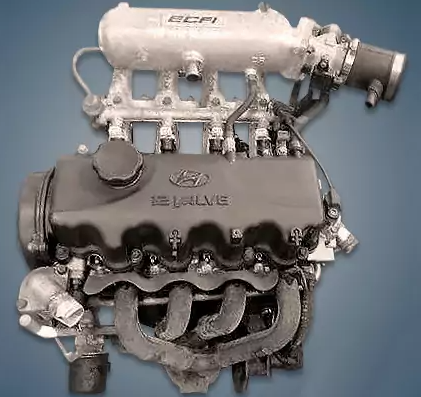
A 1.5-liter 12-valve engine under the G4EK index was the first member of the Alpha family of gasoline engines, which made its debut on the Hyundai Scoupe model in 1991. For a while, the Mitsubishi 4G15 and this motor were manufactured concurrently. The Japanese engine lacks hydraulic lifters and can be easily identified by its aluminum cover.
Distributed fuel injection, a cast-iron cylinder block, an aluminum 12-valve SOHC head with hydraulic lifters, a straightforward timing belt drive, and an extremely modern dual coil ignition system are all common features of the Korean motor’s design for its era. Apart from the atmospheric modification, a supercharged version featuring a Garrett TB1501 turbine was also manufactured.
G4EA, G4EH, G4EE, G4EB, G4EC, G4ER, G4EK, and G4ED are all part of the Alpha series.
The engine was mounted on:
- Hyundai Accent 1 (X3) in 1994 – 1999;
- Hyundai Lantra 2 (RD) in 1995 – 2000;
- Hyundai Scoupe 1 (X2) in 1991 – 1996.
Specifications
| Production years | 1991-2000 |
| Displacement, cc | 1495 |
| Fuel system | distributed injection |
| Power output, hp | 88 – 91 (atmospheric G4EK) 115 (turbocharged G4EK-TC) |
| Torque output, Nm | 126 – 134 (atmospheric G4EK) 170 (turbocharged G4EK-TC) |
| Cylinder block | cast iron R4 |
| Block head | aluminum 12v |
| Cylinder bore, mm | 75.5 |
| Piston stroke, mm | 83.5 |
| Compression ratio | 10.0 (atmospheric G4EK) 7.5 (turbocharged G4EK-TC) |
| Features | SOHC |
| Hydraulic lifters | yes |
| Timing drive | belt |
| Turbocharging | no (atmospheric G4EK) Garrett TB1501 (turbocharged G4EK-TC) |
| Recommended engine oil | 5W-40, 10W-40 |
| Engine oil capacity, liter | 3.8 |
| Fuel type | petrol |
| Euro standards | EURO 2 |
| Fuel consumption, L/100 km (for Hyundai Lantra 1997) — city — highway — combined |
10.2 5.9 7.1 |
| Engine lifespan, km | ~300 000 |
| Weight, kg | 101.3 – 107.9 |
Disadvantages of the Hyundai G4EK engine
The majority of complaints now center on floating engine speeds caused by a dirty throttle and idle speed controller, as well as engine tripping caused by a cracked coil. During the initial years of production, there were numerous issues with build quality and some components, but these issues were resolved.
This motor’s low hydraulic lift resource is another flaw. Different versions of the reasons exist: some attribute the decrease in lubrication pressure in the system to the impending wear of the oil pump plunger, others to the poor quality of the work, and still others to the bad oil.
Due to the somewhat optimistic replacement schedule every 60,000 kilometers, many Alpha family engines failed after the timing belt broke. It frequently breaks early. It is preferable to replace the water pump in addition to the belt because its resources are also limited.
These power units use a lot of oil during runs between 100,000 and 200,000 kilometers; this is largely dependent on the car’s operating system and service quality. Usually, the oil burner can be eliminated by changing the rings or seals on the valve stem.
Unreliable attachments, shoddy engine mounts, frequent lubricant or antifreeze leaks, and ECU malfunctions brought on by muffler corrugation burnout are further weaknesses. Examine the emergency fuel cut-off mechanism if the engine won’t start.