
The group’s most well-known models, including the Accent, Elantra, Matrix, and Getz, were equipped with the 1.6-liter 16-valve Hyundai G4ED engine, which was manufactured in Korea between 2000 and 2012. This unit came in two versions: one with and one without an inlet phase regulator of the CVVT type.
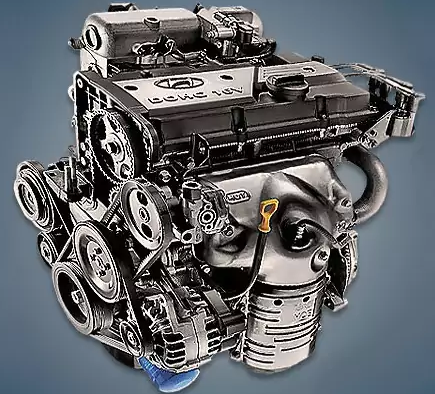
The Alpha family’s 1.6-liter engine made its debut on the Hyundai Elantra model in 2000. It was a traditional power unit with distributed fuel injection, an aluminum 16-valve cylinder head with hydraulic compensators, an in-line cast-iron cylinder block, a combined timing drive, and a belt and short chain connecting the camshafts.
This engine’s initial modifications increased its horsepower from 103 to 107 and its torque from 141 to 146 Nm. A version with an inlet dephaser that produced 112 horsepower and 146 Nm debuted in 2005. The Kia Rio, Cerato, and certain Hyundai Elantra models were equipped with such a power unit.
G4EA, G4EH, G4EE, G4EB, G4EC, G4ER, G4EK, and G4ED are all part of the Alpha series.
The engine was mounted on:
- Hyundai Accent 2 (LC) in 2003 – 2005; Accent 3 (MC) in 2005 – 2012;
- Hyundai Coupe 1 (RD) in 2001 – 2002; Coupe 2 (GK) in 2002 – 2006;
- Hyundai Elantra 3 (XD) in 2000 – 2009;
- Hyundai Getz 1 (TB) in 2002 – 2011;
- Hyundai Matrix 1 (FC) in 2001 – 2010;
- Kia Cerato 1 (LD) in 2003 – 2009;
- Kia Rio 2 (JB) in 2005 – 2011.
Specifications
| Production years | 2000-2012 |
| Displacement, cc | 1599 |
| Fuel system | distributed injection |
| Power output, hp | 103 – 112 |
| Torque output, Nm | 141 – 146 |
| Cylinder block | cast iron R4 |
| Block head | aluminum 16v |
| Cylinder bore, mm | 76.5 |
| Piston stroke, mm | 87 |
| Compression ratio | 10.0 |
| Hydraulic lifters | yes |
| Timing drive | chain & belt |
| Phase regulator | yes (for the 2005 version) |
| Turbocharging | no |
| Recommended engine oil | 5W-30, 5W-40 |
| Engine oil capacity, liter | 3.8 |
| Fuel type | petrol |
| Euro standards | EURO 3/4 |
| Fuel consumption, L/100 km (for Hyundai Getz 2007) — city — highway — combined |
7.6 5.1 6.0 |
| Engine lifespan, km | ~350 000 |
| Weight, kg | 115.4 |
Disadvantages of the Hyundai G4ED engine
The primary complaints about this motor, which is dependable, center on its erratic performance brought on by clogged nozzles, throttle assembly contamination, or idle speed controller. The ignition system’s coils and wires are frequently the culprit as well.
The official handbook states that the timing belt should only be replaced once every 90,000 kilometers, but numerous instances of it breaking at lower mileage are reported, and the valves typically bend at this point. Additionally, remember to replace the chain connecting the camshafts every two belt changes.
At 150,000 kilometers, this engine may start to use a little bit of oil. This is typically due to valve stem seal wear, and changing them is always beneficial. However, the rings have probably already been installed if the engine uses more than one liter per 1000 kilometers.
The power unit’s short-lived engine mounts, hydraulic lifters, and permanently leaking gaskets and seals are also weak points; at 100,000 kilometers, they occasionally knock violently. A fuel filter or gasoline pump should be the first place to look for the source of poor starting.