
From 1999 to 2012, a Korean company assembled the 2.7-liter V6 Hyundai G6BA engine, which was fitted to top versions of well-known models like the Sonata, Magentis, Santa Fe, and Tucson. This power unit underwent a gas modification under its own index, L6BA.
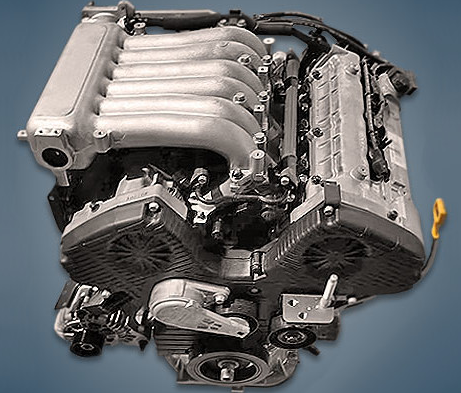
The G6AV engine, which was essentially a 24-valve version of the 2.5-liter Mitsubishi 6G73 engine, was replaced by Hyundai’s own V6 unit in 1999. An aluminum cylinder block with a closed cooling jacket and a different timing belt—which rotates the intake camshafts and connects the exhaust camshafts to them via a chain—are two of the variations.
Other than that, it is the same six-cylinder V-shaped engine with a 60° camber angle, two aluminum DOHC heads with hydraulic lifters, a contemporary ignition system, and an intake manifold that has been fitted with a unique VIS-type geometry change system.
The G6BP and G6BV engines are also part of the Delta family.
The engine was mounted on:
- Hyundai Coupe 2 (GK) in 2001 – 2008;
- Hyundai Sonata 4 (EF) in 2001 – 2012;
- Hyundai Santa Fe 1 (SM) in 2000 – 2012;
- Hyundai Tucson 1 (JM) in 2004 – 2009;
- Hyundai Trajet 1 (FO) in 1999 – 2008;
- Kia Magentis 1 (GD) in 2001 – 2006; Magentis 2 (MG) in 2005 – 2006;
- Kia Opirus 1 (GH) in 2003 – 2006;
- Kia Sportage 2 (KM) in 2004 – 2010.
Specifications
| Production years | 1999-2012 |
| Displacement, cc | 2656 |
| Fuel system | distributed injection |
| Power output, hp | 165 – 182 |
| Torque output, Nm | 230 – 250 |
| Cylinder block | aluminum V6 |
| Block head | aluminum 24v |
| Cylinder bore, mm | 86.7 |
| Piston stroke, mm | 75 |
| Compression ratio | 10.0 |
| Features | VIS, DOHC |
| Hydraulic lifters | yes |
| Timing drive | chain & belt |
| Turbocharging | no |
| Recommended engine oil | 5W-30, 5W-40 |
| Engine oil capacity, liter | 5.5 |
| Fuel type | petrol |
| Euro standards | EURO 3/4 |
| Fuel consumption, L/100 km (for Hyundai Tucson 2007) — city — highway — combined |
13.2 8.2 9.9 |
| Engine lifespan, km | ~400 000 |
| Weight, kg | 148 (185 with attachments) |
Disadvantages of the Hyundai G6BA engine
The swirl flaps of the geometry change system are installed in the intake manifold, and their bolts have a tendency to unscrew and fall straight into the engine combustion chamber. This is a very dependable power unit with a lot of resources, but it has a weakness.
Although the thick timing belt on this engine lasts longer than the planned 60,000 kilometers, leaks in the oiling or an unreliable hydraulic tensioner frequently destroy it. The motor typically just doesn’t start when the belt jumps, and it bends the valves when it breaks.
Owners of cars with such engines frequently complain about the oil burner. Near 200,000 kilometers, a slight lubricant consumption starts to show up and increases significantly with mileage. The most common causes are stuck rings or hardened valve stem seals.
A relatively small number of attachments, high-voltage wires, a crankshaft pulley, hydraulic lifters, and all sensors are among the unit’s weak points. Additionally, because the throttle, idle speed controller, or injectors are contaminated, the engine speed is continuously floating here.