
Many of the company’s mid-size models, including the Ceed, i20, i30, and Soul, are equipped with the 1.6-liter Hyundai G4FC engine, which has been assembled at the plant in China since 2006.
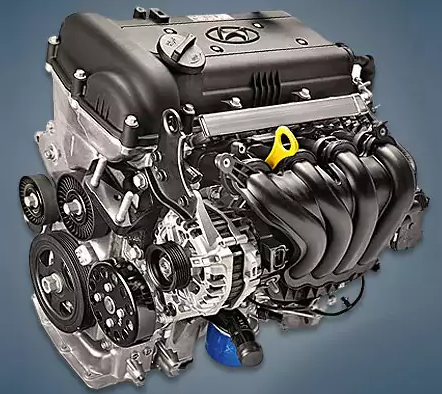
G4FA, G4FL, G4FS, G4FC, G4FD, G4FG, G4FJ, G4FM, G4FP, G4FT, and G4FU are members of the Gamma family.
The 1.4 and 1.6 liter Gamma engines took the place of the Alpha series engines in 2006. Both motors have the same structural components: a timing chain drive, a plastic intake manifold without a geometry change system, an aluminum block with an open cooling jacket, an aluminum 16-valve DOHC block head without hydraulic lifters, and an inlet dephaser. The initial engines in the series had distributed fuel injection, just like their predecessors.
The Gamma family of engines started switching to the stricter Euro 5 standard in 2009, and a large ram’s horn exhaust manifold was replaced with a tiny catalytic converter. After that, catalyst crumbs started to seep into the cylinders, causing scuffing issues.
Specifications
| Production years | since 2006 |
| Displacement, cc | 1591 |
| Fuel system | distributed injection |
| Power output, hp | 120 – 128 |
| Torque output, Nm | 154 – 158 |
| Cylinder block | aluminum R4 |
| Block head | aluminum 16v |
| Cylinder bore, mm | 77 |
| Piston stroke, mm | 85.4 |
| Compression ratio | 10.5 |
| Features | DOHC |
| Hydraulic lifters | no |
| Timing drive | chain |
| Phase regulator | yes |
| Turbocharging | no |
| Recommended engine oil | 0W-30, 5W-30 |
| Engine oil capacity, liter | 3.7 |
| Fuel type | petrol |
| Euro standards | EURO 4/5 |
| Fuel consumption, L/100 km (for Hyundai Solaris 2015) — city — highway — combined |
8.1 4.9 6.1 |
| Engine lifespan, km | ~300 000 |
| Weight, kg | 99.8 |
The engine was installed on:
- Hyundai Accent 4 (RB) in 2010 – 2018;
- Hyundai Elantra 4 (HD) in 2006 – 2011;
- Hyundai i20 1 (PB) in 2008 – 2010;
- Hyundai ix20 1 (JC) in 2010 – 2019;
- Hyundai i30 1 (FD) in 2007 – 2012;
- Hyundai Solaris 1 (RB) in 2010 – 2017;
- Kia Carens 3 (UN) in 2006 – 2013;
- Kia Cerato 1 (LD) in 2006 – 2009; Cerato 2 (TD) in 2008 – 2013;
- Kia Ceed 1 (ED) in 2006 – 2012;
- Kia ProCeed 1 (ED) in 2007 – 2012;
- Kia Rio 3 (QB) in 2011 – 2017;
- Kia Soul 1 (AM) in 2008 – 2011;
- Kia Venga 1 (YN) in 2009 – 2019.
Disadvantages of the Hyundai G4FC engine
With the switch to Euro 5, the large “ram’s horn” exhaust manifold found on the motors of the early years of production was replaced by a contemporary collector. Since then, the issue of catalyst crumbs causing scuffing in the cylinders has gained attention.
This aluminum cylinder block has thin, low-rigidity sleeves and an open cooling jacket. Additionally, the cylinders frequently go in an ellipse with frequent overheating or active use, which is followed by a progressive lubricant consumption.
The timing chain is very useful for a quiet ride, and it typically changes around 200,000 kilometers. However, the resource is cut in half if the driver continuously accelerates the engine. Additionally, it frequently fails and the hydraulic tensioner jams because of lubricant contamination.
A few minor issues include the alternator belt frequently whistling because of a weak tensioner, short-lived engine mounts, oil leaks from under the valve covers, and floating revolutions, which are frequently caused by contaminated fuel injectors or a throttle assembly.