
First introduced in 2009, Hyundai’s 1.6-liter G4FD or 1.6 GDI engine powers several well-known Hyundai models, including the Tucson, Veloster, and Soul. This motor is unique in that it uses a direct fuel injection system and is part of the Gamma II line.
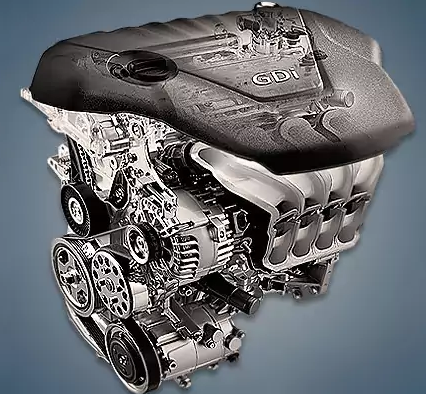
G4FA, G4FL, G4FS, G4FC, G4FD, G4FG, G4FJ, G4FM, G4FP, G4FT, and G4FU are members of the Gamma family.
As a component of the Gamma II line, the GDi direct fuel injection unit made its debut in 2010. With an aluminum block, thin-walled cast-iron liners, a 16-valve cylinder head without hydraulic lifters, an injection pump powered by an exhaust camshaft, a timing chain drive, and a unique Dual CVVT phase control system on two camshafts, this engine is entirely modern. Additionally, a plastic intake manifold with a VIS geometry change system is available.
When this unit was modified for Euro 6 in 2015, it lost roughly 5 horsepower compared to engines for Euro 5.
Specifications
| Production years | since 2009 |
| Displacement, cc | 1591 |
| Fuel system | direct injection |
| Power output, hp | 130 – 140 |
| Torque output, Nm | 160 – 167 |
| Cylinder block | aluminum R4 |
| Block head | aluminum 16v |
| Cylinder bore, mm | 77 |
| Piston stroke, mm | 85.4 |
| Compression ratio | 11.0 |
| Features | VIS |
| Hydraulic lifters | no |
| Timing drive | chain |
| Phase regulator | Dual CVVT |
| Turbocharging | no |
| Recommended engine oil | 0W-30, 5W-30 |
| Engine oil capacity, liter | 4.2 |
| Fuel type | petrol |
| Euro standards | EURO 5/6 |
| Fuel consumption, L/100 km (for Hyundai Veloster 2015) — city — highway — combined |
8.2 6.7 7.5 |
| Engine lifespan, km | ~300 000 |
| Weight, kg | 101.9 |
The engine was installed on:
- Hyundai Accent 4 (RB) in 2010 – 2017; Accent 5 (YC) since 2017;
- Hyundai Elantra 5 (MD) in 2010 – 2015;
- Hyundai i30 2 (GD) in 2011 – 2017;
- Hyundai i40 1 (VF) in 2011 – 2019;
- Hyundai ix35 1 (LM) in 2010 – 2015;
- Hyundai Tucson 3 (TL) since 2015;
- Hyundai Veloster 1 (FS) in 2011 – 2017;
- Kia Carens 4 (RP) in 2013 – 2018;
- Kia Ceed 2 (JD) in 2012 – 2018;
- Kia Cerato 2 (TD) in 2010 – 2012;
- Kia ProCeed 2 (JD) in 2015 – 2018;
- Kia Rio 3 (UB) in 2011 – 2017;
- Kia Soul 1 (AM) in 2011 – 2014; Soul 2 (PS) in 2013 – 2019;
- Kia Sportage 3 (SL) in 2010 – 2015; Sportage 4 (QL) since 2015.
Disadvantages of the Hyundai G4FD engine
The most frequent issue here is the quick buildup of carbon deposits on the intake valves, which is obviously caused by the engine’s direct fuel injection system. Decarbonization usually helps, but the engine blunts and loses a lot of power.
Cylinder seizures are common, just like in all Gamma family engines. It’s all due to a weak catalyst that is swiftly destroyed by poor fuel, and its crumbs are pulled into the combustion chambers of the engine, where they scratch the walls.
An ellipse of cylinders or stuck piston rings may also be the source of this engine’s oil consumption. There is an aluminum block with thin-walled cast-iron liners that frequently warp at high runs and an open cooling jacket.
Even though a very dependable bush-roller timing chain is installed here, there are frequently reports of its replacement after 100–150 thousand kilometers. Remember that it occasionally jumps and that pistons and valves will inevitably meet.
Due to weak gaskets, floating revs following throttle assembly contamination, and a small pump resource, owners of vehicles with this engine frequently complain about oil leaks.