
Many of the company’s large models, including the Sonata, Sorento, and Santa Fe, were equipped with the 2.4-liter Hyundai G4KE engine, which was manufactured in South Korea and the US between 2008 and 2019. For the local market, Hyundai’s Chinese plant continues to assemble this powertrain.
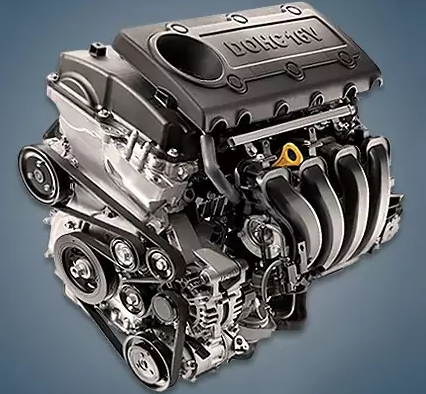
2008 saw the launch of an upgraded line of Theta II gasoline engines, which initially included two atmospheric engines with distributed injection of 2.0 and 2.4 liters. Phase shifters on both camshafts and a new intake manifold with a geometry change system were the primary distinctions from the Theta family’s predecessors. With the exception of the aluminum block, open cooling jacket, cast-iron sleeves, aluminum 16-valve cylinder head without hydraulic lifters, and timing chain, these engines are identical. The sump contains a block of balancers, just like in many large displacement 4-cylinder engines.
This power unit has been continuously improved by the manufacturer, and the engines from various years differ. For instance, a block of balancing shafts and an alternative oil pump were introduced in 2010, and since 2012, these engines have been fitted with piston cooling oil nozzles.
G4KC, G4KE, G4KG, G4KJ, and G4KK are members of the Theta 2.4L family.
The engine was mounted on:
- Hyundai Grandeur 4 (TG) in 2009 – 2011; Grandeur 5 (HG) in 2013 – 2016;
- Hyundai ix35 1 (LM) in 2009 – 2015;
- Hyundai Sonata 5 (NF) in 2008 – 2010; Sonata 6 (YF) in 2009 – 2014; Sonata 7 (LF) in 2014 – 2019;
- Hyundai Santa Fe 2 (CM) in 2009 – 2012; Santa Fe 3 (DM) in 2012 – 2018;
- Kia Cadenza 1 (VG) in 2009 – 2011;
- Kia Forte 2 (TD) in 2008 – 2013;
- Kia Magentis 2 (MG) in 2008 – 2010;
- Kia Rondo 3 (UN) in 2009 – 2010;
- Kia Sorento 2 (XM) in 2009 – 2017;
- Kia Sportage 3 (SL) in 2010 – 2016.
Specifications
| Production years | 2008-2019 |
| Displacement, cc | 2359 |
| Fuel system | distributed injection |
| Power output, hp | 170 – 180 |
| Torque output, Nm | 220 – 230 |
| Cylinder block | aluminum R4 |
| Block head | aluminum 16v |
| Cylinder bore, mm | 88 |
| Piston stroke, mm | 97 |
| Compression ratio | 10.5 |
| Hydraulic lifters | no |
| Timing drive | chain |
| Phase regulator | yes |
| Turbocharging | no |
| Recommended engine oil | 5W-30, 5W-40 |
| Engine oil capacity, liter | 5.2 |
| Fuel type | petrol |
| Euro standards | EURO 4/5 |
| Fuel consumption, L/100 km (for Hyundai Santa Fe 2011) — city — highway — combined |
11.7 7.2 8.8 |
| Engine lifespan, km | ~300 000 |
| Weight, kg | 136.3 |
Disadvantages of the Hyundai G4KE engine
The primary grievances regarding the Theta line’s powertrains are related to cylinder scuffing, which results from catalyst crumbs falling straight into the combustion chambers. Usually, a piston knock follows an initial progressive oil consumption.
The abrasive created when scuffing occurs is distributed throughout the entire oil system and accelerates the wear of the oil pump gears as well as the camshaft journals. Additionally, crankshaft liners frequently turn when the system’s oil pressure drops. Even fewer inserts with a composite coating have been installed since the end of 2011.
The chain is typically already severely stretched to runs between 100,000 and 150,000 kilometers, even though the officials claim it is made for the engine’s whole life. The main risk is that the valves are bent here and the extended chain frequently jumps.
Additionally, attachments are not the best resource for this unit because of the extremely weak gaskets and seals, which frequently result in lubricant leaks.