
In addition to the Japanese company’s models, the Mitsubishi 6G72 3.0-liter V6 engine was installed on Dodge, Chrysler, and Hyundai as the G6AT. It was manufactured at the Kyoto plant. There are five versions of this power unit, one of which is turbocharged.
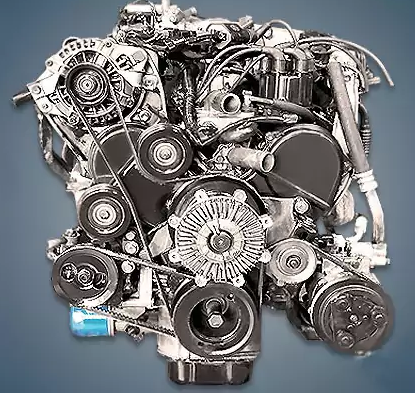
Introduced in 1986, the 6G72 engine is a potent six-cylinder power unit that survived on the assembly line until 2008. This motor has shown itself to be incredibly dependable, affordable, and simple to maintain. Car owners adore this power unit because of its outstanding performance.
The first 6G72 modification debuted in 1986. With a cast-iron block, two aluminum SOHC 12-valve heads with hydraulic lifters, and a 60° camber angle, it was a fairly traditional V6 engine at the time. The engine also had a timing belt drive and a distributed fuel injection system.
Two updated versions of this unit were introduced simultaneously in 1989: the first modification had two SOHC block heads but 24 valves, while the second, more traditional 24-valve modification already had two DOHC block heads.
Both a rare version of this engine with GDi direct fuel injection and a version with the exclusive MIVEC variable valve timing system were available in the Japanese market.
The engines 6G71, 6G72TT, 6G73, 6G74, and 6G75 are also part of the 6G7 family.
The engine was installed on:
- Mitsubishi 3000GT 1 (Z16), 3000GT 2 (Z15), Diamante 1 (F1), Diamante 2 (F3), Galant 8 (EA), Eclipse 3 (D5), L200 2 (K10), L200 3 (K70), Pajero 1 (L040), Pajero 2 (V30), Pajero 3 (V70), Pajero 4 (V90), Pajero Sport 1 (K90), Delica 4 (PA4);
- Chrysler New Yorker 13, Town & Country 1 (AS);
- Dodge Caravan 1 (AS), Caravan 2 (ES), Caravan 3 (GS), Stratus 2 (JR), Stealth 1 (Z16A), Stealth 2 (Z15A).
Specifications
| Production years | 1986-2008 |
| Displacement, cc | 2972 |
| Fuel system | distributed injection (MPI SOHC 12V) distributed injection (MPI SOHC 24V) distributed injection (MPI DOHC 24V) direct injection (GDI DOHC 24V) |
| Power output, hp | 140 – 160 (MPI SOHC 12V) 170 – 185 (MPI SOHC 24V) 195 – 225 (MPI DOHC 24V) 215 – 240 (GDI DOHC 24V) |
| Torque output, Nm | 230 – 250 (MPI SOHC 12V) 255 – 265 (MPI SOHC 24V) 265 – 280 (MPI DOHC 24V) 300 – 305 (GDI DOHC 24V) |
| Cylinder block | cast iron V6 |
| Block head | aluminum 24v |
| Cylinder bore, mm | 91.1 |
| Piston stroke, mm | 76 |
| Compression ratio | 9.0 (MPI SOHC 12V) 9.0 (MPI SOHC 24V) 10.0 (MPI DOHC 24V) 11.0 (GDI DOHC 24V) |
| Hydraulic lifters | yes |
| Timing drive | belt |
| Turbocharging | no (except for 6G72TT, for which a separate article) |
| Recommended engine oil | 5W-30, 5W-40 |
| Engine oil capacity, liter | 5.5 |
| Fuel type | petrol |
| Euro standards | EURO 2 (MPI SOHC 12V) EURO 3 (MPI SOHC 24V) EURO 3/4 (MPI DOHC 24V) EURO 5 (GDI DOHC 24V) |
| Fuel consumption, L/100 km (for Mitsubishi Pajero 1995) — city — highway — combined |
19.7 11.2 14.5 |
| Engine lifespan, km | ~400 000 |
| Weight, kg | 195 |
Disadvantages of the Mitsubishi 6G72 engine
This is a very dependable engine with a lot of resources, aside from the engines from the early years of production. Due to the wear of the rings and caps, the oil burner is the subject of the majority of complaints on the specialized forums. Since crankshaft liners are frequently cranked here, it is crucial to pay attention to the oil level.
Floating engine speeds caused by contaminated throttles, idle speed controllers, damaged wiring, or burned-out lambda probes rank second in terms of complaints. The intake manifold is removed even when changing candles, and it doesn’t always get tight.
The timing belt on this motor is extremely thick and extends beyond the recommended 90,000 kilometers. However, an oil leak from beneath a leaky gasket on the block’s front cover frequently ruins it. An oily belt’s resource is significantly diminished, and the valve typically bends when it breaks.
This unit’s unreliable ignition system, hydraulic lifters that require a lot of oil and can knock after 100,000 kilometers, and frequent coolant leaks that frequently result in overheating are additional weak points.