
The VQ37VHR, the most sophisticated engine from the VQ series, was introduced in 2007, primarily for Infiniti vehicles. This unit was designed to replace the VQ35HR. The VQ35HR block of cylinders has become slightly taller and more rigid as a result. a crankshaft with an 86 mm piston stroke, long connecting rods, and light pistons with an 11 compression ratio. As a result, the working volume could be increased from 3.5 to 3.7 liters.
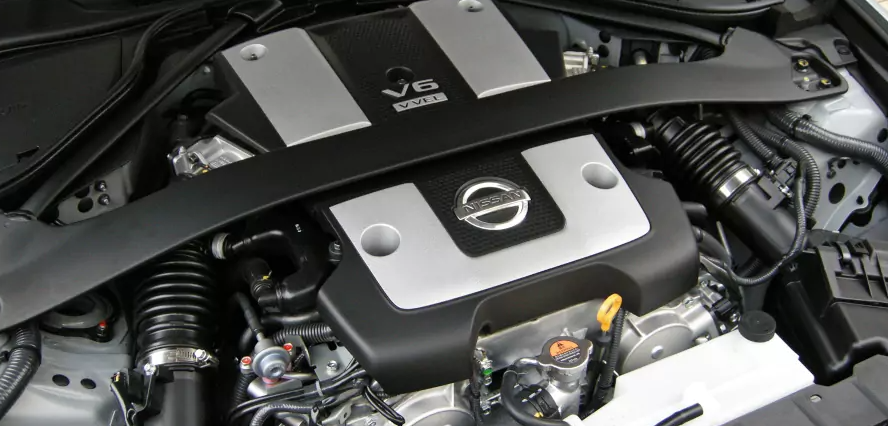
Numerous popular models of the Japanese company on the Front Midship platform are equipped with the 3.7-liter V6 Nissan VQ37VHR engine, also known as VQ37 for short, which is assembled at the company’s Iwaki plant. Currently, only the Fuga sedan and 370Z coupe have this kind of power unit installed.
Internal combustion engines are also part of the VQ30 series: VQ30DE, VQ30DET, VQ30DD, VQ35DE, VQ35DD, and VQ35HR.
The engine was installed on:
- Infiniti G37 V36, Q40 1 (V36), Q50 1 (V37), Q60 1 (CV36), M37 4 (Y51), Q70 1 (Y51), EX37 1 (J50), QX50 1 (J50), FX37 2 (S51), QX70 1 (S51);
- Nissan 370Z 6 (Z34), Fuga 2 (Y51), Skyline 12 (V36);
- Mitsubishi Proudia 2 (BY51).
Specifications
| Manufacturer | Iwaki Plant |
| Also called | VQ37 |
| Production years | 2007 |
| Cylinder block alloy | aluminum |
| Fuel system | injector |
| Configuration | V6 |
| Valves per cylinder | 4 |
| Piston stroke, mm | 86 |
| Cylinder bore, mm | 95.5 |
| Compression ratio | 11.0 |
| Displacement, cc | 3696 |
| Power output, hp | 330/7000 333/7000 355/7000 |
| Torque output, Nm / rpm | 361/5200 363/5200 365/5200 |
| Fuel type | petrol |
| Euro standards | Euro 4/5 |
| Weight, kg | 210 |
| Fuel consumption, L/100 km (for Q70) — city — highway — combined |
15.3 8.4 10.9 |
| Oil consumption, gr/1000 km | up to 500 |
| Recommended engine oil | 0W-30 / 0W-40 / 5W-30 / 5W-40 / 10W-30 / 10W-40 / 15W-40 |
| Engine oil capacity, liter | 5.4 |
| Oil change interval, km | 15000 |
| Engine lifespan, km | ~250 000 |
Disadvantages of the VQ37VHR engine
The majority of the complaints on the forums are about oil consumption, which can be attributed to a number of factors: first, the unit’s natural wear from overly aggressive operation; second, the catalysts here are afraid of bad fuel and break down rather quickly, drawing their crumbs into the combustion chambers where they scratch the walls and leave scuff marks.
The oil passageways beneath the front cover are another known issue. Paper, which was frequently already squeezed out by 100,000 kilometers, was used to make them until 2012. All of this is prone to leaks, a decrease in the unit’s lubricant pressure, and liner rotation.
This motor is extremely hot when driving actively, so it’s critical to keep an eye on the cooling system. Additionally, replace the expansion tank’s cap in addition to routinely cleaning the radiators. Remember to adjust valve clearances because there are no hydraulic lifters here.