
Only the third generation of the Maxima sedan in the J30 body, which was once very popular in the US, had the 3.0-liter Nissan VE30DE engine (also known as VE30 for short), which was produced for a very brief period of time from 1991 to 1994.
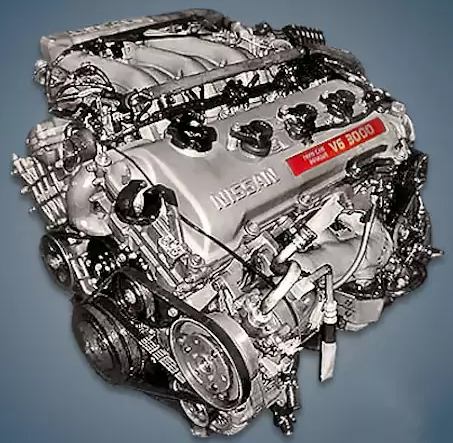
The Nissan VE30DE engine has two aluminum heads with dual overhead camshafts (DOHC), four valves per cylinder, and a cast-iron block. The VE30DE has coil-on-plug ignition, multi-point fuel injection, and variable valve timing on the intake camshafts.
There is only one internal combustion engine in the VE family.
The engine was mounted on:
- Nissan Maxima 3 (J30) in 1991 – 1994.
Specifications
| Production years | 1991-1994 |
| Displacement, cc | 2960 |
| Fuel system | distributed injection |
| Power output, hp | 190 |
| Torque output, Nm | 258 |
| Cylinder block | cast iron V6 |
| Block head | aluminum 24v |
| Cylinder bore, mm | 87 |
| Piston stroke, mm | 83 |
| Compression ratio | 10 |
| Features | no |
| Hydraulic lifters | yes |
| Timing drive | three chains |
| Phase regulator | inlet only |
| Turbocharging | no |
| Recommended engine oil | 5W-30 |
| Engine oil capacity, liter | 3.8 |
| Fuel type | petrol |
| Euro standards | EURO 2 |
| Fuel consumption, L/100 km (for Nissan Maxima 1993) — city — highway — combined |
13.9 9.8 12.4 |
| Engine lifespan, km | ~350 000 |
| Weight, kg | 220 |
Disadvantages of the VE30DE engine
The exhaust manifold gasket frequently burns out and is difficult to replace; the exhaust manifold studs frequently break off even when removed; the engine is thought to be very resourceful and frequently runs up to 500,000 kilometers without major repairs;
At 150,000 kilometers, several owners had to replace the hydraulic lifters and pump;
Diesel noise produced while the engine is running is a sign of the so-called VTC issue;
However, the primary issue with the motor is the challenge of locating replacement parts or a suitable donor.