
Only the Infiniti FX50 crossover and its upgraded version with the QX70 index were equipped with the 5.0-liter V8 Nissan VK50VE engine, also known as VK50, which was manufactured at the Japanese plant from 2008 to 2014. The engine came in two versions: the Vettel Edition, which had 420 horsepower and 520 Nm, and the stock, which had 390 horsepower and 500 Nm.
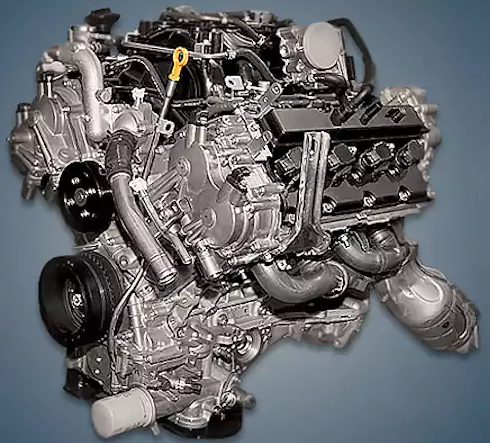
VK50VE was designed especially for the Infiniti FX50S crossover. Distributed injection, an aluminum cylinder block, two DOHC block heads without hydraulic compensators, CVTCS phase shifters on every shaft, a timing chain drive, and a unique VVEL valve lift system are all features of this vintage V8 engine. A two-throttle intake, oil nozzles, a lightweight connecting rod and piston group, and a crankshaft are some of the features.
Internal combustion engines like the VK45 and VK56 are also part of the VK family.
The engine was mounted on:
- Infiniti FX50 2 (S51) in 2008 – 2013;
- Infiniti QX70 1 (S51) in 2013 – 2014.
Specifications
| Production years | 2008-2014 |
| Displacement, cc | 5026 |
| Fuel system | distributed injection |
| Power output, hp | 390 – 420 |
| Torque output, Nm | 500 – 520 |
| Cylinder block | aluminum V8 |
| Block head | aluminum 32v |
| Cylinder bore, mm | 95.5 |
| Piston stroke, mm | 87.7 |
| Compression ratio | 10.9 |
| Features | VVEL |
| Hydraulic lifters | no |
| Timing drive | chain |
| Phase regulator | CVTCS on all shafts |
| Turbocharging | no |
| Recommended engine oil | 5W-30, 5W-40 |
| Engine oil capacity, liter | 8.0 |
| Fuel type | petrol |
| Euro standards | EURO 4/5 |
| Fuel consumption, L/100 km (for Infiniti QX70 2014) — city — highway — combined |
18.9 9.8 13.1 |
| Engine lifespan, km | ~400 000 |
| Weight, kg | 235 |
Disadvantages of the VK50VE engine
The most well-known issue with these motors is overheating, which can lead to cylinder head gasket failure and coolant seeping directly into the power unit’s oil system. The cooling radiators must be kept as clean as possible.
Active owners, the majority of whom drive Infiniti sports models, frequently have to replace the timing chain after a run of between 100,000 and 120,000 kilometers. The chains have undergone multiple upgrades from the manufacturer, and the most recent models are more durable.
The issue of scuffing in this unit is less severe because of the oil injectors, but there have been reports of oil burns on specialized forums. The primary risk is that the liners may turn if the lubricant level falls.
Additionally, the owners report frequent leaks from under the valve covers, short-lived lambda probes, a gasoline pump, and unstable idling caused by throttle contamination. Additionally, since there are no hydraulic compensators here, remember to modify the thermal clearances of the valves.