
The biggest and most potent models, including the Armada, Titan, and Infiniti QX56, were equipped with the 5.6-liter V8 Nissan VK56DE engine, which was manufactured in US factories between 2003 and 2015. There are two generations of this unit because it underwent a significant upgrade in 2007.
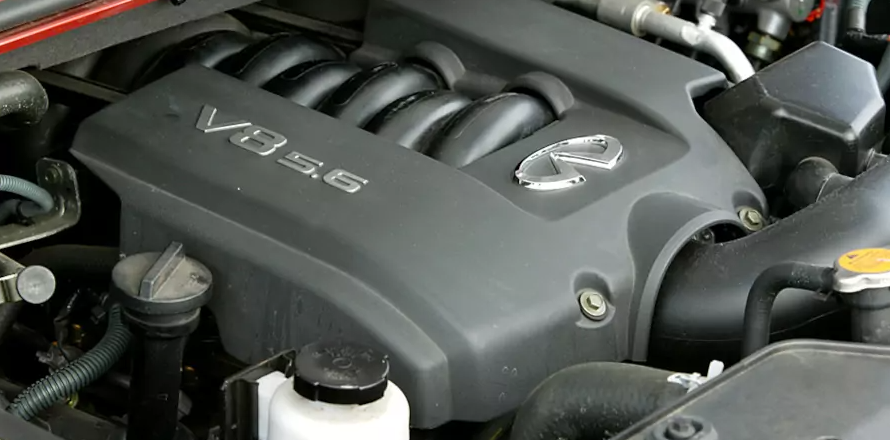
The VK45DE’s initial iteration was released in 2003. This V8 has two DOHC heads without hydraulic lifters, a multiport fuel injection system, an electronic throttle, a timing chain drive, an aluminum block with cast iron liners, and a 90° camber angle. The unit’s intake camshafts now have CVTCS phase shifters thanks to the 2007 update.
Since 2010, the Yokohama plant has produced the 5.6-liter V8 Nissan VK56VD engine, which is found in the biggest and most potent models, including the Armada, Patrol, and numerous Infiniti. Such a unit can be modified in two ways: for SUVs and for sports sedans.
A new power unit with direct injection systems and variable valve lifts of the VVEL type replaced the popular VK56DE engine at the very end of 2009. Other than that, it is a similar V8 gasoline engine with cast-iron liners and an aluminum cylinder block, two aluminum DOHC heads without hydraulic lifters, a timing chain, and a unique CVTCS variable valve timing system, but only on the intake shafts.
The Infiniti M56 and Q70 sports sedan versions of this engine, which are distinguished by a different cylinder block, CVTCS phase shifters on all camshafts, an increased compression ratio from 10.8 to 11.5, and the presence of oil nozzles for cooling pistons, are worth discussing separately.
Internal combustion engines like the VK45 and VK50VE are also part of the VK family.
The engine was mounted on:
- Infiniti QX56 1 (JA60) in 2004 – 2010;
- Infiniti QX56 2 (Z62) in 2010 – 2013;
- Infiniti QX80 1 (Z62) in 2013 – …;
- Infiniti Q70 1 (Y51) in 2013 – 2019;
- Infiniti M 4 (Y51) in 2010 – 2013;
- Nissan Armada 1 (WA60) in 2003 – 2015;
- Nissan Armada 2 (Y62) in 2016 – …;
- Nissan Patrol 6 (Y62) in 2010 – …;
- Nissan Pathfinder 3 (R51) in 2007 – 2012;
- Nissan Titan 1 (A60) in 2003 – 2015;
- Nissan Titan 2 (A61) in 2015 – …
Specifications
| Manufacturer | Decherd Plant |
| Also called | VK56 |
| Production years | 2003-2015 |
| Cylinder block alloy | aluminum |
| Fuel system | distributed injection (VK56DE) direct injection (VK56VD) |
| Configuration | V8 |
| Valves per cylinder | 4 |
| Piston stroke, mm | 92 |
| Cylinder bore, mm | 98 |
| Compression ratio | 9.8 (VK56DE) 10.8 (VK56VD) 11.5 (VK56VD for sports sedans) |
| Displacement, cc | 5552 |
| Power output, hp | 305 – 325 (VK56DE) 390 – 405 (VK56VD) 408 – 420 (VK56VD for sports sedans) |
| Torque output, Nm / rpm | 520 – 535 (VK56DE) 530 – 560 (VK56VD) 550 – 565 (VK56VD for sports sedans) |
| Fuel type | petrol |
| Euro standards | EURO 4 (VK56DE) EURO 5 (VK56VD) |
| Weight, kg | 240 (VK56DE) 225 (VK56VD) |
| Fuel consumption, L/100 km (VK56DE for Infiniti QX56 2008) — city — highway — combined |
21.9 11.5 15.3 |
| Oil consumption, gr/1000 km | up to 1000 |
| Recommended engine oil | 5W-30 / 5W-40 / 10W-30 / 10W-40 |
| Engine oil capacity, liter | 6.5 |
| Oil change interval, km | 10000 |
| Engine lifespan, km | ~400 000 |
Disadvantages of the VK56DE engine
The most well-known issue with this unit is the development of scuffing in the cylinders as a result of catalyst crumbs entering them and being destroyed by poor fuel. Oil consumption and the emergence of a diesel sound during engine operation are symptoms.
This engine’s low resource is what sets timing chains apart; they are frequently already extended for 100–150 thousand kilometers, which manifests as noisy and unstable operation.
We recommend that you keep a close eye on the engine cooling system’s condition because it can overheat quickly, breaking the gasket or leading to the cylinder head. The fan’s viscous coupling isn’t the most dependable, which makes the issue worse.
They frequently complain about an unreliable fuel pump, lambda probes that are sensitive to gasoline quality, and the engine’s difficulty starting in cold weather in specialized forums. Additionally, since there are no hydraulic lifters here, remember to adjust the valve clearance.
Disadvantages of the VK56VD engine
The most well-known issue with these engines is the development of scoring in the cylinders, which is followed by oil burn and the emergence of a diesel sound. The problem is the bending of the liners as a result of overheating, as well as the suction of crumbs into the combustion chambers from a collapsing catalyst or wear products of the injection pump pusher. A revocable company was even established to replace these motors in the US market.
Timing chains that have stretched after less than 100,000 kilometers have been reported by numerous owners, and in certain markets, a recall company has replaced them even after the warranty has expired.
The high-pressure fuel pump pusher wears out quickly as a result of using low-quality fuel, and its wear products can enter the cylinders through the oil system.
Your unit’s cooling system is prone to overheating, which can bend the liners and cause scuffs, so you need to keep a close eye on its condition.
Injector seats in this engine frequently break on runs longer than 200–250 thousand kilometers, and the VVEL valve lift system occasionally malfunctions.