
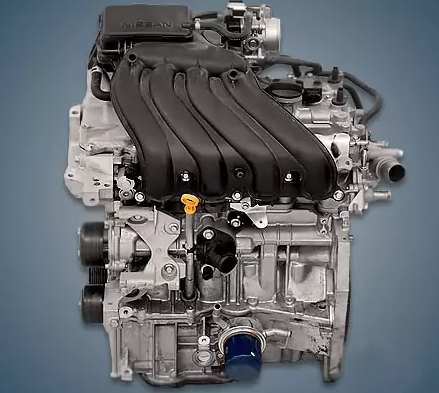
An obvious development of the Renault K4M engine is the Nissan HR16DE. The electronic control and gas distribution system were primarily updated. The engine also had two fuel injectors per cylinder, new camshafts, and a timing chain drive. The engine’s hydraulic compensators (which are adjusted by choosing pushers every 100,000 kilometers) were eliminated. The intake shaft still had the variable valve timing system. Compared to its predecessor, the engine is now more powerful, ecologically friendly, and economical.
HR10DDT, HRA2DDT, HR12DE, HR12DDR, HR13DDT, and HR15DE are members of the HR family.
The design, which included an aluminum block with cast-iron sleeves and an open cooling jacket, an aluminum 16-valve head, a timing chain drive, an inlet dephaser, and solid pushers in place of hydraulic compensators, was fairly typical for the Japanese engine industry at the time.
With two nozzles per cylinder, fuel injection is distributed but not quite typical here. The engine was able to fit into Euro 5 because of the use of an electronic throttle assembly. One or two nozzles per cylinder are modifications made to a similar Renault H4M engine.
Specifications
| Manufacturer | Yokohama Plant Dongfeng Motor Company VAZ |
| Production years | 2005-… |
| Cylinder block alloy | aluminum |
| Fuel system | injector |
| Configuration | inline |
| Number of cylinders | 4 |
| Valves per cylinder | 4 |
| Piston stroke, mm | 83.6 |
| Cylinder bore, mm | 78 |
| Compression ratio | 10.7 |
| Displacement, cc | 1598 |
| Power output, hp | 108/5600 114/6000 117/6000 |
| Torque output, Nm / rpm | 142/4000 156/4400 158/4000 |
| Fuel type | petrol |
| Euro standards | Euro 4/5 |
| Weight, kg | 110 |
| Fuel consumption, L/100 km (Sentra) — city — highway — combined |
8.9 5.5 6.4 |
| Oil consumption, gr/1000 km | up to 500 |
| Recommended engine oil | 0W-30 / 0W-40 / 5W-30 / 5W-40 / 10W-30 / 10W-40 / 10W-60 / 15W-40 |
| Engine oil capacity, liter | 4.3 |
| Oil change interval, km | 15000 |
| Engine lifespan, km | ~300 000 |
The engine was installed on:
- Nissan Cube 3 (Z12) in 2009 – 2011;
- Nissan Bluebird Sylphy G11 in 2005 – 2012;
- Nissan Juke 1 (F15) in 2010 – 2019;
- Nissan Kicks 1 (P15) in 2016 – …;
- Nissan Latio N17 in 2011 – …;
- Nissan Livina 1 (L10) in 2006 – 2019;
- Nissan Micra 3 (K12) in 2007 – 2010;
- Nissan Micra 4 (K13) in 2010 – 2017;
- Nissan Note 1 (E11) in 2006 – 2013;
- Nissan Note 2 (E12) in 2012 – 2020;
- Nissan NV200 1 (M20) in 2009 – …;
- Nissan Qashqai 1 (J10) in 2006 – 2013;
- Nissan Sentra 7 (B17) in 2012 – 2020;
- Nissan Sentra 8 (B18) in 2019 – …;
- Nissan Tiida 1 (C11) in 2007 – 2012;
- Nissan Tiida 2 (C13) in 2015 – 2016;
- Nissan Versa C11 in 2006 – 2018;
- Nissan Wingroad Y12 in 2008 – 2017.
Disadvantages of the HR16DE engine
During its initial years of production, this very dependable motor had a number of issues: it was difficult to start in cold weather, the muffler’s exhaust pipe ring frequently burned out, and a widespread recall campaign was conducted to replace the faulty ignition unit relay.
The motor’s progressive oil consumption is its most well-known drawback. Oil burn usually starts after 100,000 kilometers, and only replacing the rings can make it go away. It frequently shows up at low mileage and goes away after switching to a different lubricant.
Stretching the timing chain at a range of roughly 200,000 km is a challenge for many owners. Replacement frequently calls for an expensive phase regulator in addition to the chain, sprockets, and shoes.
We won’t blame the power unit’s minor issues on the alternator belt’s constant whistling and the requirement to modify valve clearances.