
The Nissan Skyline R31 was equipped with the first RB20 engines. Because of their red caps, early double overhead camshaft engines are known as “Red Top.” The ECCS engine management system was employed in later iterations. The 2-liter RB20 engines came in the following versions: RB20E, RB20ET, RB20DE, RB20DE NEO, RB20DET, RB20P, and RB20DET-R.
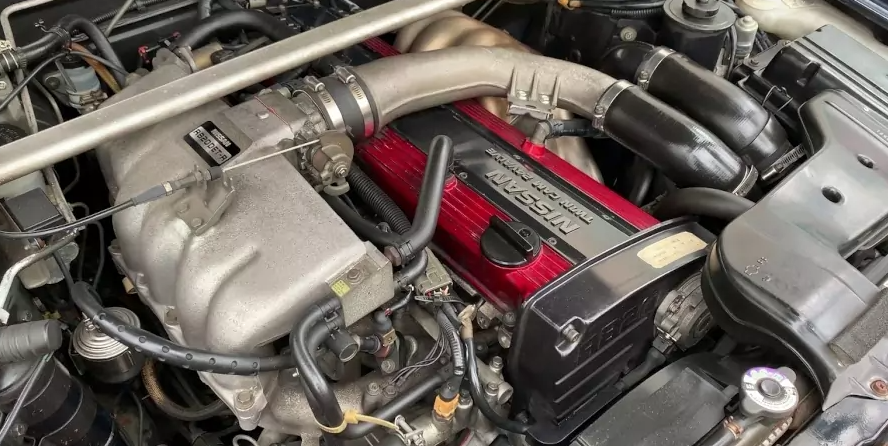
The initial model, the RB20E, had a short-stroke crankshaft and a cast-iron cylinder block with six in-line cylinders. covered with a single-shaft aluminum cylinder head that has two valves for each cylinder. Depending on the generation, power ranges from 115 to 130 horsepower. In addition to being extremely weak, this version is generally not widely distributed and does not represent anything intriguing.
RB20ET: The subsequent model, which debuted in 1985, was identical to the RB20E but lacked an intercooler and had a 0.5 bar turbocharger. 170 horsepower, or 145 horsepower in some variations.
The most well-known 2-liter RB is the RB20DE, which debuted in 1985. The two-shaft, 24-valve cylinder head with separate ignition coils, along with a new crankshaft, connecting rods, pistons, intake system, and control unit, are its primary differences from the RB20E. Lift 7.3/7.8 mm, camshafts 232/240. These motors increased in power from 150 to 165 horsepower. When the timing belt breaks, the RB20DE engine bends the valve.
Since 2000, RB20DE NEO, a modified RB20DE, has been manufactured at the end of production. In addition to a crankshaft, an intake system, a modernized cylinder head without hydraulic lifters, and a control unit, these motors stand out for their enhanced environmental performance. This engine has 155 horsepower.
In 1985, RB20DET was released. This motor is a turbo version of the one mentioned above. A 16V turbocharger running at 0.5 bar of pressure was installed in these power plants. The compression ratio was lowered to 8.5 during supercharging, and 270 cc/min nozzles were used along with replacements for the pistons, connecting rods, crankshaft, cylinder head gasket, and control unit. NICS intake, 248/240 timing, and 7.8/7.8mm lift were used in early models (RB20DET Red top for Skyline R31). Depending on the model, the engine produced 180–190 horsepower with them. Later, starting in 1988, they started using 240/240 camshafts, 7.8/7.8 mm lift, and the ECCS system. This motor, which has been increased to 215 horsepower at 6400 rpm, is also known as the RB20DET Silver top. The naturally aspirated RB25DE, which had roughly the same power, replaced the RB20DET engine in 1993.
With the exception of RB20DE NEO engines, which lack hydraulic lifters, RB20DE/DET engines do not require valve adjustment. The RB20’s belt-driven timing drive requires a replacement every 80–100,000 kilometers.
Specifications
| Manufacturer | Yokohama plant |
| Also called | RB20 |
| Production years | 1984-2002 |
| Cylinder block alloy | cast iron |
| Fuel system | injector |
| Configuration | inline |
| Number of cylinders | 6 |
| Valves per cylinder | 2 4 |
| Piston stroke, mm | 69.7 |
| Cylinder bore, mm | 78 |
| Compression ratio | 10.0 (RB20DE) 9.5 (RB20E) 8.5 (RB20DET) |
| Displacement, cc | 1998 |
| Power output, hp | 115/5600 125/5600 130/5600 145/6000 150/6400 155/6400 165/6400 170/6000 180/6400 190/6400 215/6400 |
| Torque output, Nm / rpm | 167/4000 172/4400 181/4000 206/3200 181/5200 184/5200 186/5600 216/3200 226/3600 240/4800 265/3200 |
| Fuel type | petrol |
| Euro standards | EURO 2/3 |
| Weight, kg | 230 (RB20DE) 245 (RB20DET) |
| Fuel consumption, L/100 km (for Nissan Fairlady 1988) — city — highway — combined |
13.3 9.7 11.0 |
| Oil consumption, gr/1000 km | up to 500 |
| Recommended engine oil | 0W-30 / 5W-30 / 5W-40 / 10W-30 / 10W-40 |
| Engine oil capacity, liter | 4.2 |
| Oil change interval, km | 15000 |
| Normal engine operating temperature, °C | ~90 |
| Engine lifespan, km | ~400 000 |
Disadvantages of the RB20 engine
The primary drawback of these engines is their high fuel consumption for such a working volume, despite their reputation for dependability and minimal operational issues.
Statistics show that the ignition system has the highest number of failures;
The timing belt resource is limited to 100,000 kilometers;
Low-quality gasoline is not tolerated by the engine; the nozzles here clog very quickly.