
Produced between 1989 and 2001, the 2.0-liter Nissan SR20DET engine was used in both the company’s sports cars and charged versions of its civilian models. This motor’s modifications can be identified by the color of the valve cover, which can be red, silver, or black.
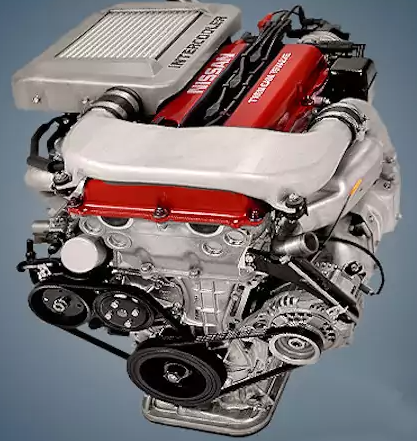
The SR16VE, SR18DE, SR20DE, SR20VE, and SR20VET internal combustion engines are also part of the SR family.
The engine was mounted on:
- Nissan 200SX S14 in 1993 – 1999;
- Nissan Avenir 1 (W10) in 1995 – 1997; Avenir 2 (W11) in 1998 – 2001;
- Nissan Bluebird U12 in 1989 – 1990; Bluebird U13 in 1991 – 1995;
- Nissan Liberty M12 in 1998 – 2000;
- Nissan Pulsar N14 in 1990 – 1995;
- Nissan R’nessa N30 in 1997 – 2001;
- Nissan Silvia S13 in 1989 – 1994; Silvia S14 in 1993 – 2000; Silvia S15 in 1999 – 2002;
- Nissan Sunny N14 in 1990 – 1995.
Specifications
| Production years | 1989-2001 |
| Displacement, cc | 1998 |
| Fuel system | distributed injection |
| Power output, hp | 200 – 250 |
| Torque output, Nm | 270 – 300 |
| Cylinder block | aluminum R4 |
| Block head | aluminum 16v |
| Cylinder bore, mm | 86 |
| Piston stroke, mm | 86 |
| Compression ratio | 8.3 – 8.5 |
| Features | no |
| Hydraulic lifters | yes |
| Timing drive | chain |
| Phase regulator | at the inlet |
| Turbocharging | Garrett T25 or T28 |
| Recommended engine oil | 5W-30 |
| Engine oil capacity, liter | 3.7 |
| Fuel type | petrol |
| Euro standards | EURO 2/3/4 |
| Fuel consumption, L/100 km (for Nissan Silvia 2000) — city — highway — combined |
14.7 8.4 11.2 |
| Engine lifespan, km | ~300 000 |
| Weight, kg | 180 |
Disadvantages of the SR20DET engine
This motor silently travels over 300–350 thousand kilometers if you don’t save on oil;
Cheap oil reduces resources, particularly for the turbine, by clogging the channels;
The timing chain frequently stretches and begins to rattle after 200–250 thousand kilometers; the idle speed controller or mass air flow sensor should be checked for the cause of floating speed;
Wear on the rubber-metal engine mounts is indicated by strong vibrations;
There are frequent leaks from beneath the oil pressure sensor and crankshaft oil seal;
They might not be able to withstand the rocker after heavy use, at which point the engine is over.