
From 1983 to 1991, a Japanese plant produced the 3.0-liter Nissan VG30ET engine, which was used in both the civilian Cedric and Gloria and the sports models of the 300ZX family. Two distinct turbines were used in the production of this unit, resulting in varying power.
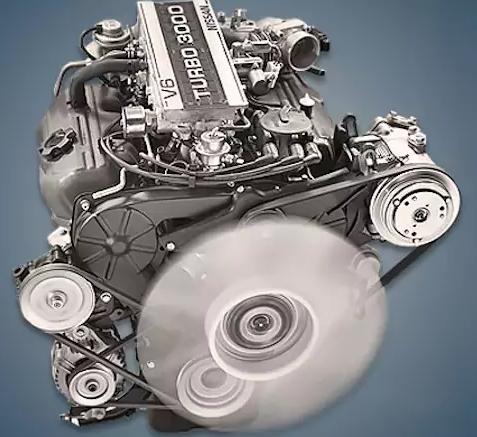
Internal combustion engines VG30i, VG30E, VG30DE, VG30DET, and VG30DETT are also members of the VG30 family.
The engine was mounted on:
- Nissan Cedric 6 (Y30) in 1983 – 1987;
- Nissan Cedric 7 (Y31) in 1987 – 1991;
- Nissan Gloria 7 (Y30) in 1983 – 1987;
- Nissan Gloria 8 (Y31) in 1987 – 1991;
- Nissan Leopard F30 in 1984 – 1986;
- Nissan 300ZX 3 (Z31) in 1983 – 1989.
Specifications
| Production years | 1983-1991 |
| Displacement, cc | 2960 |
| Fuel system | distributed injection |
| Power output, hp | 195 – 230 |
| Torque output, Nm | 295 – 345 |
| Cylinder block | cast iron V6 |
| Block head | aluminum 12v |
| Cylinder bore, mm | 87 |
| Piston stroke, mm | 83 |
| Compression ratio | 7.8 – 8.3 |
| Features | no |
| Hydraulic lifters | yes |
| Timing drive | belt |
| Phase regulator | no |
| Turbocharging | Garrett T3 or T25 |
| Recommended engine oil | 5W-30 |
| Engine oil capacity, liter | 3.9 |
| Fuel type | petrol |
| Euro standards | EURO 1/2 |
| Fuel consumption, L/100 km (for Nissan Cedric 1986) — city — highway — combined |
16.7 12.3 14.5 |
| Engine lifespan, km | ~360 000 |
| Weight, kg | 225 |
Disadvantages of the VG30ET engine
The most hazardous condition is a broken crankshaft shank, which frequently causes the valves to bend;
The studs break when the exhaust manifold gasket is removed after it burns out;
Future header cracking is a risk associated with replacing the studs with thicker ones;
After 100,000 kilometers, pump leaks and hydraulic lifter knocks are common. The timing belt resource is roughly 70,000 kilometers, and when it breaks, the valve nearly always bends.