
Since it was installed on numerous models between 1983 and 1999, the 3.0-liter Nissan VG30E engine—also known as the VG30 for short—was one of the largest V6 engines available at the time. There was a version of the device with a phase regulator, and it was manufactured in a variety of capacities.
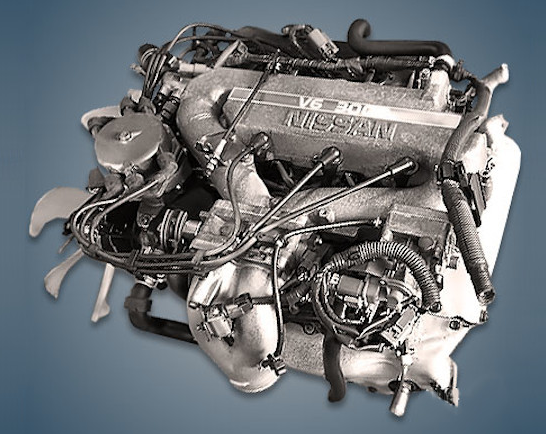
Internal combustion engines VG30i, VG30ET, VG30DE, VG30DET, and VG30DETT are also members of the VG30 family.
The engine was mounted on:
- Nissan 200SX 3 (S12) in 1983 – 1988;
- Nissan 300ZX 3 (Z31) in 1983 – 1989;
- Nissan Cedric 6 (Y30) in 1983 – 1987; Cedric 7 (Y31) in 1987 – 1991; Cedric 8 (Y32) in 1991 – 1995; Cedric 9 (Y33) in 1995 – 1999;
- Nissan Gloria 7 (Y30) in 1983 – 1987; Gloria 8 (Y31) in 1987 – 1991; Gloria 9 (Y32) in 1991 – 1995;
- Nissan Laurel 5 (C32) in 1984 – 1989;
- Nissan Maxima 2 (PU11) in 1984 – 1988; Maxima 3 (J30) in 1988 – 1994;
- Nissan Navara 1 (D21) in 1990 – 1997;
- Nissan Pathfinder 1 (WD21) in 1990 – 1995;
- Nissan Quest 1 (V40) in 1992 – 1998;
- Nissan Terrano 1 (WD21) in 1990 – 1995;
- Infiniti M30 1 (F31) in 1989 – 1992.
Specifications
| Production years | 1983-1999 |
| Displacement, cc | 2960 |
| Fuel system | distributed injection |
| Power output, hp | 150 – 180 |
| Torque output, Nm | 240 – 260 |
| Cylinder block | cast iron V6 |
| Block head | aluminum 12v |
| Cylinder bore, mm | 87 |
| Piston stroke, mm | 83 |
| Compression ratio | 9.0 – 11.0 |
| Features | no |
| Hydraulic lifters | yes |
| Timing drive | belt |
| Phase regulator | as an option |
| Turbocharging | no |
| Recommended engine oil | 5W-30 |
| Engine oil capacity, liter | 3.9 |
| Fuel type | petrol |
| Euro standards | EURO 2/3 |
| Fuel consumption, L/100 km (for Nissan Terrano 1994) — city — highway — combined |
16.2 11.6 14.5 |
| Engine lifespan, km | ~390 000 |
| Weight, kg | 220 |
Disadvantages of the VG30E engine
The primary issue is the valves’ bending as a result of the crankshaft shank breaking;
Additionally, there are frequent water pump leaks and hydraulic lifter noises; remember to service the timing belt every 70,000 kilometers;
The studs break when the collector is removed, and the outlet gasket frequently burns out;
The collector frequently cracks after these studs are replaced with thicker ones.