
Naturally, the 1.5-liter GA15DS and GA15DE are the most popular models in the GA series. It was originally a carbureted GA15DSB, but the GA15DE with multi-point electronic fuel injection took its place in 1994. Electronic injection allowed the torque to reach 135 N*m at 4000 rpm and the power to reach 105 horsepower at 6000 rpm. Up until 2000, this engine was manufactured.
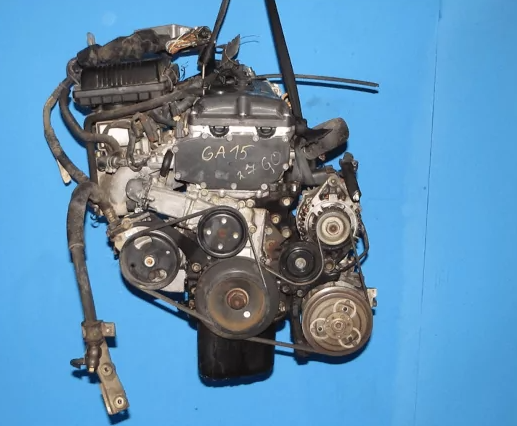
These engines share the same basic design as all other GA series 4-cylinder engines: a cast-iron block, an aluminum head, and two timing chains because an intermediate shaft connects the crankshaft to the camshafts. Hydraulic lifters are not present.
Various engine indexes because of the fuel system:
- The carbureted GA15S model has a single 12-valve camshaft. For its class 85 horsepower and 123 Nm, its power is pretty respectable.
- GA15E: Everything is the same here, but distributed injection is more expensive. As a result, this modification was able to achieve a little bit more, specifically 97 horsepower and 128 Nm.
- The GA15DS produces an amazing 94 horsepower and 126 Nm thanks to a carburetor and a sixteen-valve head with two camshafts.
- The most popular version, GA15DE, has a DOHC 16v head, multi-point injection, and a proprietary ECCS electronic control system. power equivalent to 135 Nm and 105 horsepower.
The engine was installed on:
- Nissan Sunny 2 (B12) in 1985 – 1990;
- Nissan Pulsar N13 in 1986 – 1990;
- Nissan Pulsar N14 in 1990 – 1995;
- Nissan Pulsar N15 in 1995 – 2000;
- Nissan AD 2 (Y10) in 1990 – 1998;
- Nissan Presea 1 (R10) in 1990 – 1995;
- Nissan Presea 2 (R11) in 1995 – 2000;
- Nissan Rasheen in 1994 – 2000.
Specifications
| Manufacturer | Yokohama Plant |
| Production years | 1987-2000 |
| Cylinder block alloy | cast iron |
| Fuel system | carburetor / injector |
| Configuration | inline |
| Number of cylinders | 4 |
| Valves per cylinder | 3 / 4 |
| Piston stroke | 88 |
| Cylinder bore | 73.6 |
| Compression ratio | 9.2 – 9.9 |
| Displacement | 1498 |
| Power output | 85/6000 94/6000 97/6000 104/6000 |
| Torque output | 123/3600 126/3600 128/4400 135/4000 |
| Fuel type | petrol |
| Euro standards | Euro 1/2 |
| Weight | 147 |
| Fuel consumption | city 7.5 l. | highway 4.5 l. | combined 5.9 L/100 km |
| Oil consumption | up to 500 g /1000 km |
| Recommended engine oil: | 5W-30 /5W-40 / 10W-30 /10W-40 |
| Engine oil capacity, liter: | 3.2 |
| Oil change interval | 15000 km |
| Engine lifespan, km | ~300 000 |
Disadvantages of the GA15DE engine
The most troublesome versions are those with carburetors. The fuel system’s clogged strainers and jets cause the engine to operate erratically or even just stall. Usually, poor-quality gasoline is the problem.
The most common cause of unstable engine speeds on injection engines is a clogged idle valve. The assembly itself can be easily removed for cleaning, but since there is a possibility of unintentionally damaging it, it is best to get in touch with an expert.
Additionally, if the mass air flow sensor fails, the power unit’s speed may float. Since cleaning it doesn’t help him for very long, seasoned service members typically offer to replace it.
It is time to evaluate the state of the oil scraper rings and caps if a powerful oil burner has started, producing more than a liter per 1000 kilometers. About half of the time, replacing them is beneficial. If not, prepare for a costly makeover.
The drying of the gasket can occasionally cause the lubricant to fly out into the pipe, which should prevent fuel, lubricants, and crankcase gases from entering the intake. The crankcase ventilation filter must be inspected; if it is covered in oil, this is undoubtedly the cause.