
Produced in Japan since 2021, the 1.5-liter Nissan KR15DDT (or simply KR15) or 1.5 VC-Turbo engine is exclusively found on the X-Trail crossover and its American equivalent, known as the Rogue. The presence of a compression ratio control system sets this three-cylinder engine apart.
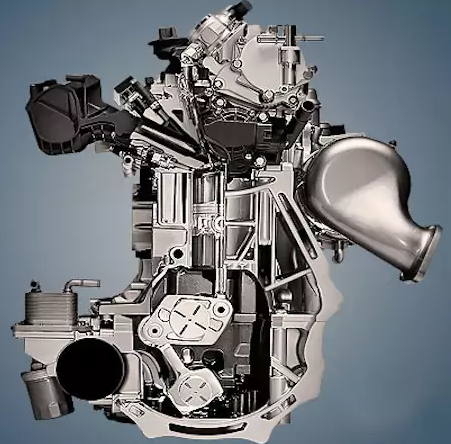
The KR20DDET, an internal combustion engine, is another member of the KR family.
The engine was mounted on:
- Nissan Rogue 3 (T33) in 2021 – …;
- Nissan X-Trail 4 (T33) in 2022 – …
Specifications
| Production years | 2021-… |
| Displacement, cc | 1477 – 1497 |
| Fuel system | direct injection |
| Power output, hp | 201 |
| Torque output, Nm | 300 |
| Cylinder block | aluminum R3 |
| Block head | aluminum 12v |
| Cylinder bore, mm | 84 |
| Piston stroke, mm | 88.9 – 90.1 |
| Compression ratio | 8.0 – 14.0 |
| Features | ATR |
| Hydraulic lifters | no |
| Timing drive | chain |
| Phase regulator | on two shafts |
| Turbocharging | yes |
| Recommended engine oil | 5W-30 |
| Engine oil capacity, liter | 4.7 |
| Fuel type | petrol |
| Euro standards | EURO 6 |
| Fuel consumption, L/100 km (for Nissan X-Trail 2022) — city — highway — combined |
9.0 7.1 8.1 |
| Engine lifespan, km | ~200 000 |
| Weight, kg | 125 |
Disadvantages of the KR15DDT engine
The statistics of this turbo engine’s malfunctions have not yet been gathered; thus far, the only complaints on specialized forums have been about the Start-Stop system’s frequent malfunctions;
Because of the direct injection system, soot quickly overgrows the intake valves here;
The engine’s primary issue is where to fix the compression ratio system; there are no hydraulic lifters, and valve clearances must be changed every 100,000 kilometers.