
The GA16DE engine features multipoint fuel injection and a four-stroke, four-cylinder, in-line vertical cylinder arrangement. Between 1990 and 2002, the 1.6-liter Nissan GA16DE engine was manufactured in three different versions: with and without a phase regulator, as well as in the gas version GA16DNE for several developing nations.
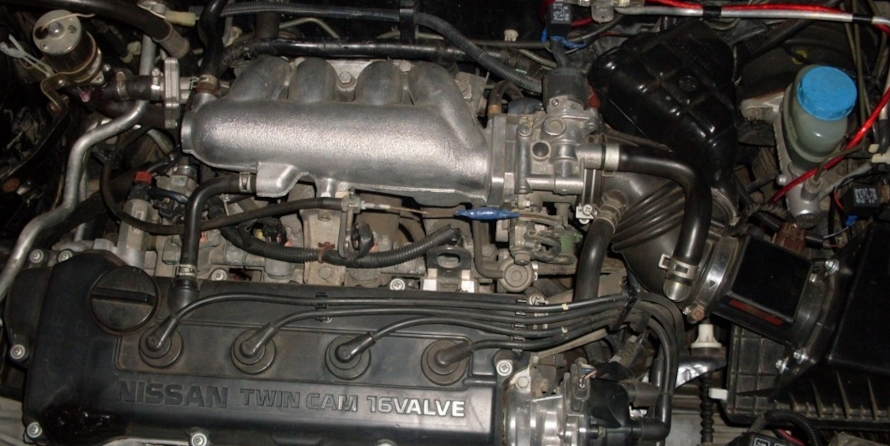
The engine was installed on:
- Nissan 100NX B13 in 1990 – 1993;
- Nissan 200SX B14 in 1994 – 1999;
- Nissan Almera 1 (N15) in 1995 – 2000;
- Nissan AD 2 (Y10) in 1995 – 1998;
- Nissan Primera 1 (P10) in 1990 – 1996;
- Nissan Primera 2 (P11) in 1995 – 2002;
- Nissan Pulsar N14 in 1990 – 1995;
- Nissan Pulsar N15 in 1995 – 2000;
- Nissan Sentra 3 (B13) in 1990 – 1994;
- Nissan Sentra 4 (B14) in 1994 – 1999;
- Nissan Presea 1 (R10) in 1990 – 1995;
- Nissan Wingroad Y10 in 1996 – 1998.
From 1987 until 1997, a Japanese company manufactured the Nissan GA16S carburetor engine. There were models with the GA16E injector and the GA16i single injection in addition to the carburetor internal combustion engine. 85–95 horsepower and 125–135 Nm of torque are produced by the engine. adhered to the EURO 0 environmental class. Pulsar N13 (1987–1990), Sunny N13 (1987–1991), Sentra 3 (B13) (1992–1997), and Tsuru B13 (1992–1997) all had the engine installed.
A Japanese facility produced the Nissan GA16DS carburetor engine between 1990 and 1997. 89–97 horsepower and 130–135 Nm of torque are produced by the engine. Additionally, it met EURO 0 environmental standards. The engine was mounted on the 100NX B13 Avenir 1 (W10) from 1990 to 1997.
Specifications GA16DE
| Production years | 1990-2002 |
| Displacement, cc | 1597 |
| Fuel system | injector |
| Power output, hp | 100 – 105 (version without phase regulator) 110 – 115 (version with phase regulator) |
| Torque output, Nm | 125 – 135 (version without phase regulator) 140 – 150 (version with phase regulator) |
| Cylinder block | cast iron R4 |
| Block head | aluminum 16v |
| Cylinder bore, mm | 76 |
| Piston stroke, mm | 88 |
| Compression ratio | 9.8 (version without phase regulator) 9.9 (version with phase regulator) |
| Features | ECCS |
| Hydraulic lifters | no |
| Timing drive | chain |
| Phase regulator | no (version without phase regulator) at the NVCS inlet (version with phase regulator) |
| Turbocharging | no |
| Recommended engine oil | 5W-30 |
| Engine oil capacity, liter | 3.2 |
| Fuel type | petrol |
| Euro standards | EURO 2/3 |
| Fuel consumption, L/100 km (for Nissan Primera 1998) — city — highway — combined |
9.6 5.9 7.2 |
| Engine lifespan, km | ~320 000 |
| Weight, kg | 150 |
Disadvantages of the GA16DE engine
A clogged idle valve or a problem with the mass air flow sensor’s readings are indicated by floating speed and jerks. Regular cleaning is usually effective in treating these symptoms, but occasionally a replacement—which will be expensive—may be required.
Since the engine oil gets under the valve cover due to the crankcase ventilation gasket’s warping, it is important to periodically check its condition. An oil-covered air filter is the first indication of such an issue under the hood.
Progressive oil consumption frequently starts here on runs longer than 200,000 km. Replacing piston rings or valve stem seals may be sufficient in certain situations, but a complete and costly repair is usually required.
Noise starts to appear in the timing area around the same mileage. The phases will go off course, consumption will rise, the motor will operate unevenly, and there is, of course, a chance of a chain jump with disastrous results if you pull with the replacement of chains.