
From 1998 to 2002, the company produced the 2.0-liter Volkswagen APK 8v engine, which was fitted to the fourth Golf and numerous other models built on its platform. According to the AQY index, this power unit was basically an EURO 2 version of the popular motor.
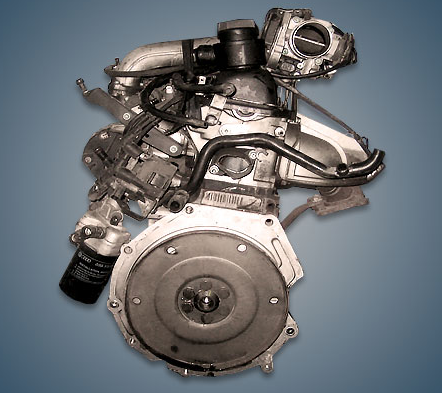
APK, AQY, AXA, AZJ, AZM, ALT, and BSX are all part of the EA113-2.0 series.
Specifications
| Production years | 1998-2002 |
| Displacement, cc | 1984 |
| Fuel system | injector |
| Power output, hp | 116 |
| Torque output, Nm | 170 |
| Cylinder block | cast iron R4 |
| Block head | aluminum 8v |
| Cylinder bore, mm | 82.5 |
| Piston stroke, mm | 92.8 |
| Compression ratio | 10.5 |
| Features | SOHC |
| Hydraulic lifters | yes |
| Timing drive | belt |
| Phase regulator | no |
| Turbocharging | no |
| Recommended engine oil | 5W-30 |
| Engine oil capacity, liter | 4.0 |
| Fuel type | petrol |
| Euro standards | EURO 2 |
| Fuel consumption, L/100 km (for VW Golf 1999) — city — highway — combined |
10.8 6.0 7.9 |
| Engine lifespan, km | ~420 000 |
The engine was installed on:
- Skoda Octavia 1 (1U) in 1999 – 2002;
- Volkswagen Beetle 1 (9C) in 1998 – 2001;
- Volkswagen Bora 1 (1J) in 1998 – 2001;
- Volkswagen Golf 4 (1J) in 1998 – 2001.
Disadvantages of the VW APK engine
This motor is structurally straightforward, and its owners are only concerned about minor issues.
There are only a few ignition system components that are unreliable.
The crankshaft position sensor, coolant temperature sensor, and idle speed controller are the most frequently malfunctioning electrical components.
The timing belt has an estimated 90,000 kilometers of resource, but the valves do not bend when it breaks.
Rings typically lie and oil consumption shows up by 250,000 km.