
Overview & Design Features
The Acura K20C1 is a high-performance, turbocharged 2.0-liter (1996 cc) inline four-cylinder engine, a flagship product from Honda’s revered K-series family, specifically designed for enthusiast-oriented vehicles. Introduced in the highly anticipated FK8 Honda Civic Type R, this engine marked a significant departure from Honda’s traditional naturally aspirated performance philosophy, embracing forced induction to deliver prodigious power and torque across a broad RPM range. Its development prioritized both track capability and street drivability, making it a benchmark in the compact performance segment.
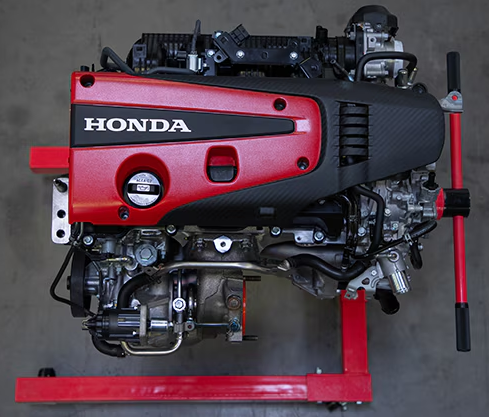
Engineering excellence defines the K20C1. The engine features an all-aluminum cylinder block and cylinder head, contributing to its light weight and efficient heat dissipation. It utilizes a robust, high-strength forged crankshaft and connecting rods, paired with lightweight aluminum pistons, to withstand the stresses of turbocharging and high RPM operation. Fuel delivery is managed by a direct injection system, precisely delivering fuel into the combustion chambers for optimal efficiency and power output. Honda’s renowned VTEC (Variable Valve Timing and Lift Electronic Control) technology is applied to the exhaust camshaft, complemented by Dual Variable Timing Control (VTC) on both intake and exhaust camshafts, allowing for intricate control over valve overlap and timing to maximize volumetric efficiency across the RPM band. A single-scroll MHI turbocharger, integrated with an electronic wastegate, provides instant boost response and sustains high power output.
The K20C1 engine was first deployed in the 2017-2021 Honda Civic Type R (FK8 generation). Its evolution continued with updated versions appearing in the 2023+ Honda Civic Type R (FL5 generation) and the 2024+ Acura Integra Type S, both offering slightly increased power outputs while maintaining the core engineering principles. The engine is exclusively paired with a short-throw six-speed manual transmission in these high-performance applications.
Technical Specifications
| Specification | Value (FK8 Honda Civic Type R) |
|---|---|
| Displacement | 1996 cc (2.0 L) |
| Max Power | 306 hp (228 kW) @ 6500 RPM |
| Max Torque | 400 Nm (40.8 kg*m) @ 2500-4500 RPM |
| Fuel Type | Premium Unleaded (91+ RON / 93 AKI) |
| Fuel Consumption (Combined) | 8.9 l/100 km (26.4 MPG US) |
| Engine Type | Inline 4-cylinder, DOHC, VTEC Turbo, Direct Injection |
| Compression Ratio | 9.8:1 |
| Cylinder Bore | 86.0 mm |
| Piston Stroke | 86.0 mm |
| Valvetrain | DOHC i-VTEC (exhaust), Dual VTC |
| Valves per Cylinder | 4 (16 valves total) |
| Additional Info | Single-scroll turbocharger, forged crankshaft & rods, aluminum pistons, drive-by-wire throttle. |
Common Problems & Reliability
The K20C1 engine generally exhibits high reliability, a testament to Honda’s engineering standards, especially considering its high-performance nature. However, certain characteristics inherent to direct injection and turbocharged engines warrant attention. Carbon buildup on the intake valves is a potential concern over high mileage due to the direct injection system not washing the valve stems with fuel. While less prevalent than in some other direct-injected engines, periodic inspection and cleaning (e.g., walnut blasting) can be beneficial, particularly for vehicles used extensively on track or in stop-and-go traffic. Another area of minor concern for some owners has been slightly elevated oil consumption in certain units, though this is not widespread and often falls within manufacturer specifications. Lastly, while the turbocharger unit itself is robust, like all forced induction systems, it operates under extreme heat and pressure. The longevity of the turbocharger is heavily influenced by proper warm-up and cool-down procedures, as well as regular, high-quality oil changes. Aggressive track use without adequate cooling or maintenance can accelerate wear on turbo components.
With diligent maintenance and proper driving habits, the K20C1 engine is engineered for a substantial service life, with many units expected to exceed 250,000 kilometers (150,000 miles) before requiring any major internal overhaul.
Maintenance Tips & Service Schedule
- Engine Oil: Utilize a high-quality synthetic oil, typically 0W-20 or 5W-30, meeting API SN or SP standards. Adhere to Honda’s Maintenance Minder system for oil change intervals, or a maximum of 12,000 km (7,500 miles) or one year, whichever comes first, under normal driving conditions. For track use or aggressive driving, more frequent changes (e.g., every 5,000 km / 3,000 miles) are highly recommended.
- Oil Filter: Replace the oil filter with every oil change using an OEM-equivalent or higher-quality filter.
- Spark Plugs: Replace iridium-tipped spark plugs approximately every 80,000-100,000 km (50,000-60,000 miles). Using OEM specified plugs is crucial for optimal performance and preventing misfires under boost.
- Air Filter: Inspect the engine air filter regularly and replace it every 24,000-48,000 km (15,000-30,000 miles), or more frequently in dusty environments.
- Coolant: The engine utilizes a long-life coolant. Flush and replace the coolant every 160,000 km (100,000 miles) or 10 years, whichever comes first.
- Timing Chain: The K20C1 employs a robust timing chain system designed for the life of the engine. Regular oil changes are vital to its longevity. Inspection of the chain and tensioner is recommended at very high mileages (e.g., 200,000+ km / 120,000+ miles) if abnormal noise is present.
- Fuel Quality: Consistent use of premium unleaded fuel (91+ RON / 93 AKI) is mandatory to prevent pre-ignition and ensure optimal performance and engine health.
Conclusion
The Acura K20C1 stands as a highly commendable engine choice for performance enthusiasts and used vehicle buyers seeking a potent and reliable powertrain. Its blend of Honda’s legendary VTEC technology with modern turbocharging and direct injection delivers exhilarating performance without significantly sacrificing longevity. While attention to common direct injection maintenance items like potential carbon buildup is prudent, the engine’s fundamental design is robust. Provided a vehicle equipped with a K20C1 has a documented history of consistent maintenance, particularly with high-quality oil and premium fuel, it represents a safe and rewarding investment, promising many years of engaging driving.