
From 1996 to 2007, the company produced the 1.6-liter 8-valve Audi AEH engine, which was fitted on well-known models like the A3 8L, Golf 4, and Toledo 2. This motor has one lambda probe, no EGR, and a mass air flow sensor rather than an absolute pressure sensor in order to meet Euro 2 environmental standards.
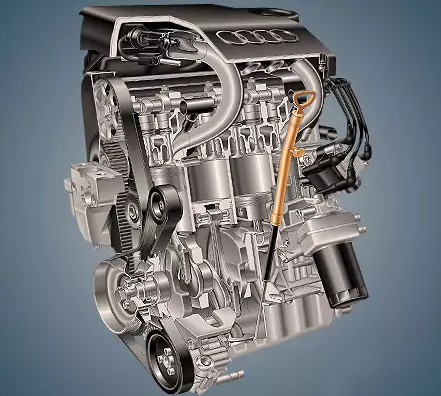
The EA113-1.6 series includes: AEH, AHL, AKL, ALZ, ANA, APF, ARM, AVU, BFQ, BGU, BSE, BSF.
Specifications
| Production years | 1996-2007 |
| Displacement, cc | 1595 |
| Fuel system | injector |
| Power output, hp | 100 |
| Torque output, Nm | 145 |
| Cylinder block | aluminum R4 |
| Block head | aluminum 8v |
| Cylinder bore, mm | 81 |
| Piston stroke, mm | 77.4 |
| Compression ratio | 10.2 |
| Features | SOHC |
| Hydraulic lifters | yes |
| Timing drive | belt |
| Phase regulator | no |
| Turbocharging | no |
| Recommended engine oil | 5W-40 (approval: VW 502 00 or VW 505 00) |
| Engine oil capacity, liter | 4.5 |
| Fuel type | petrol |
| Euro standards | EURO 2 |
| Fuel consumption, L/100 km (for Audi A3 1997) — city — highway — combined |
10.5 5.9 7.6 |
| Engine lifespan, km | ~350 000 |
The engine was installed on:
- Audi A3 1 (8L) in 1996 – 2001;
- Seat Cordoba 1 (6K) in 1999 – 2002;
- Seat Ibiza 2 (6K) in 1999 – 2002;
- Seat Leon 1 (1M) in 1999 – 2005;
- Seat Toledo 2 (1M) in 1998 – 2004;
- Skoda Octavia 1 (1U) in 1997 – 2007;
- Volkswagen Bora 1 (1J) in 1998 – 2005;
- Volkswagen Golf 4 (1J) in 1998 – 2004;
- Volkswagen Polo 3 Classic (6V) in 1999 – 2001.
Disadvantages of the Audi AEH engine
This motor is easy to use, dependable, and has a lot of resources when properly maintained.
Air leaks are the cause of many of his issues; see pipes and manifold.
Additionally, some of the ignition system’s parts are not the best resources.
Here, a leaky fuel injector is frequently the cause of poor starting.
Rings are a common cause of oil consumption after 200,000 kilometers of run.