
Since 1998, Munich vehicles have been equipped with M57 series motors, which have taken the place of the diesel M51. The new M57D30 engine was built using the same cast-iron cylinder block as its predecessor, but it has larger cylinders. This aluminum DOHC head has twenty-four valves. The timing chain, which has an enormous resource, provides the camshafts’ rotation; under typical circumstances, chain replacement may not be required at all.
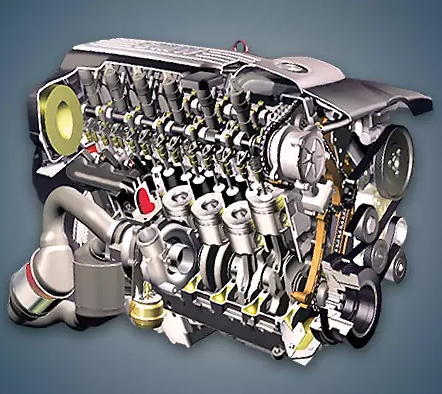
An upgraded version of the M57TUD30 was put into production in 2002; a crankshaft with a 90 mm piston stroke was installed to tighten the working volume to a round figure of 3 liters. A Garrett GT2260V was installed in place of the turbine, and the control unit is DDE5. The most potent model, known as the M57TUD30 TOP, had pistons with a compression ratio of 16.5, two different-sized BorgWarner KP39 and K26 turbochargers (boost 1.85 bar), and control over the entire DDE6 ECU.
The M57TU2 version, which was introduced in 2005, featured a lightweight aluminum cylinder block, an upgraded Common rail, piezo injectors, new camshafts, increased engine inlet valves to 27.4 mm, a cast-iron exhaust manifold, a Garrett GT2260VK turbocharger, a DDE6 ECU, and all of these features complied with Euro-4 standards. The M57TU2D30 TOP, which had two BorgWarner KP39 and K26 turbines (boost pressure 1.98 bar) and a DDE7 ECU, took the place of the TOP model.
The M57 family also includes: M57D25.
The engine was installed on:
- BMW 3-Series E46 in 1999 – 2006; 3-Series E90 in 2005 – 2012;
- BMW 5-Series E39 in 1998 – 2004; 5-Series E60 in 2003 – 2010;
- BMW 6-Series E63 in 2007 – 2010; 6-Series E64 in 2007 – 2010;
- BMW 7-Series E38 in 1998 – 2001; 7-Series E65 in 2001 – 2008;
- BMW X3 E83 in 2003 – 2010;
- BMW X5 E53 in 2001 – 2006; X5 E70 in 2007 – 2010;
- BMW X6 E71 in 2008 – 2010;
- Land Rover Range Rover 3 (L322) in 2002 – 2006.
Specifications
| Production years | 1998-2012 |
| Displacement, cc | 2926 2993 (TU, TU2) |
| Fuel system | Common Rail |
| Power output, hp | 184 – 193 204 – 272 (TU) 231 – 286 (TU2) |
| Torque output, Nm | 390 – 410 410 – 560 (TU) 500 – 580 (TU2) |
| Cylinder block | cast iron R6 aluminum R6 (TU2) |
| Block head | aluminum 24v |
| Cylinder bore, mm | 84 |
| Piston stroke, mm | 88 90 (TU, TU2) |
| Compression ratio | 18.0 16.5 – 18.0 (TU) 17.0 – 18.0 (TU2) |
| Features | intercooler |
| Hydraulic lifters | yes |
| Timing drive | chain |
| Phase regulator | no |
| Turbocharging | Garrett GT2556V Garrett GT2260V (TU) BorgWarner KP39 + K26 (TOP-version TU) Garrett GT2260VK (TU2) BorgWarner KP39 + K26 (TOP-version TU2) |
| Recommended engine oil | 5W-40 |
| Engine oil capacity, liter | 6.75 7.5 (TU) 8.0 (TU2) |
| Fuel type | diesel |
| Euro standards | EURO 2/3 EURO 3 (TU) EURO 3/4 (TU2) |
| Fuel consumption, L/100 km (for BMW 530d 2002) — city — highway — combined |
9.7 5.6 7.1 |
| Engine lifespan, km | ~400 000 |
Disadvantages of the M57D30 engine
Here, the intake manifold flaps may abruptly separate and drop into the cylinders;
The crankshaft pulley being destroyed after 100,000 kilometers is regarded as another branded failure;
TU and TU2 versions’ exhaust manifolds frequently burst, so it’s best to replace them with cast iron ones;
The pipes leading to the turbine become fogged when the oil separator malfunctions;
The fuel equipment and turbine resources are diminished by low-quality fuel and oil.