
By adapting its geometry to the M51’s specifications, the 2.5-liter BMW M57D25 engine was developed based on the 3-liter M57D30. cylinder block made of cast iron. The M57D25 employs a twin-shaft cylinder head with four valves per cylinder, in contrast to the M51. The camshafts are rotated by the timing chain, which has a high level of dependability and may never cause you any issues with regular maintenance.
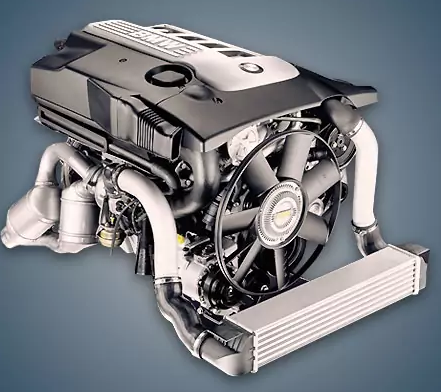
BMW M57D25 engine modifications:
- The basic M57D25 with a Garrett GT2052V turbine was known as the M57D25O0 (2000–2003). Engine torque is 350 Nm at 2000–2500 rpm and power is 163 horsepower at 4000 rpm. The 150 horsepower version was for the Opel Omega B and was known as the Y25DT there. The engine was on the E39 525d.
- The M57D25O1 (2004–2007) is an upgraded M57TU series motor. The torque is 400 Nm at 2000–2750 rpm, and the power has increased to 177 horsepower at 4000 rpm. A Garrett GT2056V turbocharger powers it. The BMW E60 525d has this engine.
The M57 family also includes: M57D30.
The engine was installed on:
- BMW E39 525d in 2000 – 2004;
- BMW E60 525d in 2003 – 2007.
Specifications
| Production years | 2000-2007 |
| Displacement, cc | 2497 |
| Fuel system | Common Rail |
| Power output, hp | 163 (M57D25O0) 177 (M57D25O1) |
| Torque output, Nm | 350 (M57D25O0) 400 (M57D25O1) |
| Cylinder block | cast iron R6 |
| Block head | aluminum 24v |
| Cylinder bore, mm | 80 |
| Piston stroke, mm | 82.8 |
| Compression ratio | 17.5 (M57D25O0) 18.0 (M57D25O1) |
| Features | intercooler |
| Hydraulic lifters | yes |
| Timing drive | chain |
| Phase regulator | no |
| Turbocharging | Garrett GT2052V (M57D25O0) Garrett GT2056V (M57D25O1) |
| Recommended engine oil | 5W-30, 5W-40 |
| Engine oil capacity, liter | 6.5 (M57D25O0) 7.25 (M57D25O1) |
| Fuel type | diesel |
| Euro standards | EURO 2/3 |
| Fuel consumption, L/100 km (for BMW 525d E39) — city — highway — combined |
9.2 5.3 6.7 |
| Engine lifespan, km | ~400 000 |
Disadvantages of the M57D25 engine
Knowing the engine’s ideal temperature and keeping a close eye on this indicator are essential because failing to do so increases the risk of overheating, which can result in a broken cylinder head.
Additionally, these power units have an issue with swirl flaps, just like versions of the M47 line of motors. They may fall off while driving and enter the engine, particularly if the starter is running for a long time. This could result in the motor needing a significant overhaul. It is best to remove the shutters and then set up the software to function normally without these devices in order to prevent such issues.
Unnecessary sounds and noises may be heard during the movement. A failed crankshaft damper can also lead to this rather common issue. It must be inspected and replaced if needed.
There is frequently a situation where the engine power starts to fade and the cabin smells like diesel. An exhaust manifold crack is the cause of this problem. It will need to be replaced; the cast-iron version is preferable.
Nozzles don’t cause issues until they reach the 100,000-kilometer milestone. Additionally, turbines have a long lifespan and can travel over 300–400 thousand kilometers if high-quality oil is used. The service life may be shortened if low-quality grease is used.
Since this motor lasts for a considerable amount of time when prompt and high-quality maintenance is provided, owners generally do not have many negative things to say about it. It will be feasible to travel approximately 500,000 kilometers without requiring significant power unit repairs if premium fuel and the right engine oil are used.