
The newest and biggest model in the B Series is the Cummins ISB 6.7-liter in-line six-cylinder turbo diesel engine. With 350 horsepower and 881 Nm of torque, the ISB 6.7 is Cummins’ most potent diesel engine for light and medium trucks.
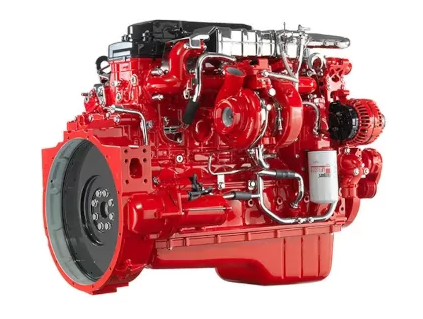
ISB 5.9, its predecessor, was produced for nearly a decade. In terms of emissions and fuel consumption, it was out of date at the time and had reached the limit of improvement. The ISB 6.7 engine was the solution to the market’s need for a new engine for medium-duty buses and trucks. 6.7 ISB had a larger piston stroke (124 mm) and bore (107 mm). Its working volume was raised to 6.7 liters as a result. Cast iron still makes up the engine block. A 24-valve cast iron cylinder head, akin to ISB 5.9, sits atop the block. The ISB 6.7 cylinder head differs from the ISB 5.9 cylinder head in that it has holes on the intake manifold side for the sensor. Although there are numerous differences from the most recent generation 5.9L, the general design is unchanged. The 6.7-liter Cummins engine included new emission-reducing equipment, an electronically controlled fuel pump, and high pressure common rail fuel injection.
The new version was created in order to comply with the Federal Emissions Legislation’s more stringent requirements. It was the first Cummins diesel engine to have a particulate filter (DPF) installed in its first year of production, 2007. Over 90% of the soot in exhaust gases is eliminated by the DPF filter. Soot particles are filtered by the diesel particulate filter’s ceramic matrix, which is heated by the exhaust gases to regenerate them at high temperatures. A cooled exhaust gas recirculation (EGR) system was another feature of the engine. The engine received extra EGR cooler, SCR (Selective Catalytic Reduction), and DEF (Diesel Exhaust Fluid) for the 2010 model year. To help the soot regeneration process at a lower temperature, DEF is injected into the DPF. Therefore, two liters of DEF are used for every 100 liters of diesel fuel.
Another intriguing new engine feature is the Holset HE351VE Variable Geometry Turbocharger (VGT). By obstructing the exhaust gas flow, this turbocharger can raise the temperature inside the DPF and lower emissions. Additionally, the VGT has an integrated exhaust gas braking system. Limiting the flow of exhaust gases is how engine braking works. Every ISB6.7 engine has an air-to-air intercooler.
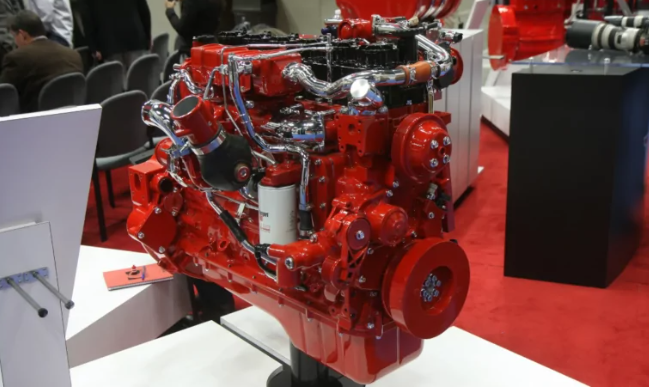
The 2017 engines are already producing up to 1220 Nm of torque because the improvement process has never stopped over the last ten years of production. A smaller version, the ISB 4.5 (4.5-liter inline four-cylinder turbodiesel), was also based on the ISB 6.7.
Specifications
| Manufacturer | Cummins |
| Production years | 2007-… |
| Cylinder block alloy | cast iron |
| Cylinder head material | cast iron |
| Fuel type | diesel |
| Fuel system | direct injection, electronically controlled high pressure common rail injection system |
| Configuration | inline |
| Number of cylinders | 6 |
| Valves per cylinder | 4 |
| Valve train layout | OHV |
| Cylinder bore, mm | 107 |
| Piston stroke, mm | 124 |
| Displacement | 6.7 liters |
| Configuration | Four-stroke, turbocharged |
| Compression ratio | 17.3:1 |
| Displacement | 305-385 hp at 2800-3000 rpm |
| Torque output | 827-1220 Nm at 1500-1700 rpm |
| Weight (dry) | 476-522 kg |
| Firing order | 1-5-3-6-2-4 |
| Oil volume | 11.4 liter (with filter) |
| Oil change interval | 24000 km or 6 months (12000 km or 6 months for models 2007-2012) |
| Installed | Dodge Ram pickups, buses, medium trucks |
Frequent problems and reliability ISB 6.7L Cummins
The most dependable Cummins B-Series engine is the 6.7 ISB. As usual, fits are poor. The common rail injection system and exhaust equipment are frequently problematic. All engines with exhaust gas recirculation are susceptible to clogging. DPF has a lifespan of roughly 160,000 kilometers. Installing DPF removal kits, which are unquestionably less expensive but less ecologically friendly, is a decision made by some owners. Remember that extended downtime is unacceptable for VGT. At 300K miles or more, fuel injectors ISB6.7 also need maintenance. According to owners, the 6.7 injectors are more dependable than the 5.9 version’s injectors.
Modifications
| Model | Euro standards, (UNECE) |
Gross power, hp at rpm |
Torque output (maximum), Nm at rpm |
| ISB 6.7 250 | 4, 96-02 | 250 / 2500 | 990 / 1500 |
| ISB 6.7 275 | 4, 96-02 | 275 / 2500 | 990 / 1500 |
| ISB 6.7 300 | 4, 96-02 | 300 / 2500 | 1100 / 1700 |
| ISB 6.7 E4 210B | 4, 49-05B1(C) | 210 / 2300 | 800 / 1400 |
| ISB 6.7 E4 245 | 4, 49-05B1(C) | 245 / 2500 | 950 / 1400 |
| ISB 6.7 E4 245B | 4, 49-05B1(C) | 245 / 2300 | 950 / 1400 |
| ISB 6.7 E4 270B | 4, 49-05B1(C) | 270 / 2300 | 970 / 1400 |
| ISB 6.7 E4 300 | 4, 49-05B1(C) | 300 / 2500 | 1100 / 1400 |
| ISB 6.7 E5 210B | 5, 49-05B2(G) | 210 / 2300 | 790 / 1300 |
| ISB 6.7 E5 250 | 5, 49-05B2(G) | 250 / 2500 | 950 / 1300 |
| ISB 6.7 E5 250B | 5, 49-05B2(G) | 250 / 2300 | 1020 / 1300 |
| ISB 6.7 E5 285 | 5, 49-05B2(G) | 285 / 2500 | 1020 / 1300 |
| ISB 6.7 E5 300 | 5, 49-05B2(G) | 300 / 2500 | 1100 / 1300 |
| ISB 6.7 E5 310 | 5, 49-05B2(G) | 310 / 2300 | 1200 / 1400 |