
From 2004 to 2017, the company manufactured two generations of 1.6-liter Ford 1.6 TDCi diesel engines: the first had an 8-valve cylinder head and the second had a 16-valve cylinder head. In other vehicles, these diesel engines are referred to as Volvo D4162T, Peugeot 1.6 HDi, Mazda 1.6 CiTD, and D4164T.
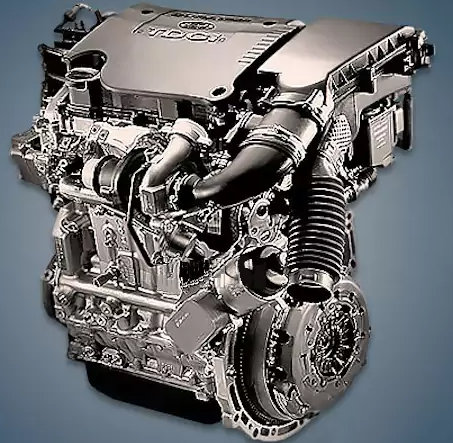
Ford 1.6 TDCi engine design
A 1.6-liter diesel engine known as the DV6 and 1.6 HDi, developed in collaboration with PSA, made its debut on the original Ford C-Max model in 2003. An aluminum block with cast-iron sleeves, an aluminum 16-valve cylinder head with two camshafts and hydraulic compensators, a combined timing drive consisting of a belt and a small chain with a tensioner between the camshafts, and a Bosch Common Rail fuel system with electromagnetic nozzles were all fairly standard components for that era. A standard Mitsubishi TD025 turbine was installed in engine modifications with less than 100 horsepower, while a Garrett GT1544V variable geometry turbocharger was installed in more potent models.
The second generation engines, which had an 8-valve head and eventually eliminated the somewhat troublesome chain connecting the two camshafts, were introduced in 2010. These engines even had a more recent Common Rail fuel system installed: Bosch models up to 100 horsepower had electromagnetic injectors, while Siemens models (later renamed Continental) had piezo injectors. A standard Mitsubishi TD02H2 turbocharger was fitted to weak engines, while a Garrett GTC1244VZ variable geometry turbine was fitted to versions with more than 100 horsepower.
Specifications for versions with 16-valve cylinder head
| Production years | 2004-2010 |
| Displacement, cc | 1560 |
| Fuel system | Common Rail |
| Power output, hp | 75 – 109 |
| Torque output, Nm | 185 – 240 |
| Cylinder block | aluminum R4 |
| Block head | aluminum 16v |
| Cylinder bore, mm | 75 |
| Piston stroke, mm | 88.3 |
| Compression ratio | 18.0 – 18.3 |
| Fuel type | diesel |
| Euro standards | EURO 4 |
| Engine lifespan, km | ~350 000 |
We are aware of roughly five distinct modifications in total, and each has multiple additional versions:
| HHJF (75 hp / 185 Nm) | Ford Fiesta Mk6 |
| HHJA (90 hp / 205 Nm) | Ford Fiesta Mk5, Fusion Mk1 |
| HHJC (90 hp / 215 Nm) | Ford Fiesta Mk6 |
| GPDA (90 hp / 215 Nm) | Ford Focus Mk2, C-Max Mk1 |
| G8DA (109 hp / 240 Nm) | Ford Focus Mk2, C-Max Mk1 |
Specifications for versions with 8-valve cylinder head
| Production years | 2010-2017 |
| Displacement, cc | 1560 |
| Fuel system | Common Rail |
| Power output, hp | 75 – 115 |
| Torque output, Nm | 200 – 270 |
| Cylinder block | aluminum R4 |
| Block head | aluminum 16v |
| Cylinder bore, mm | 75 |
| Piston stroke, mm | 88.3 |
| Compression ratio | 16.0 |
| Fuel type | diesel |
| Euro standards | EURO 5 |
| Engine lifespan, km | ~350 000 |
We are aware of approximately eleven distinct modifications, each of which has multiple additional versions:
| UBGA (75 hp / 220 Nm) | Ford Connect Mk2 |
| T3JA (95 hp / 200 Nm) | Ford Fiesta Mk6 |
| TZJA (95 hp / 205 Nm) | Ford Fiesta Mk6 |
| T3JB (95 hp / 215 Nm) | Ford B-Max Mk1 |
| T3DA (95 hp / 230 Nm) | Ford Focus Mk3, C-Max Mk2 |
| TZGA (95 hp / 230 Nm) | Ford Connect Mk2 |
| NGDA (105 hp / 270 Nm) | Ford Focus Mk3 |
| T1BA (115 hp / 270 Nm) | Ford Mondeo Mk4 |
| T1DA (115 hp / 270 Nm) | Ford Focus Mk3, C-Max Mk2 |
| T1GA (115 hp / 270 Nm) | Ford Connect Mk2 |
| T1WA (115 hp / 270 Nm) | Ford Galaxy Mk2 |
Disadvantages of the Ford 1.6 TDCi engine
The chain tensioner between the camshafts and the camshaft cams wore out very quickly in the early years of this diesel engine’s manufacturing. Unstable engine operation and a change in valve timing resulted from this. The node was then upgraded.
In general, the turbine’s geometry change mechanism is particularly unreliable. Additionally, a clogged coarse oil filter in the fitting that connects the oil supply pipe to the cylinder block is frequently the cause of its failure.
The Bosch CP4S1 high-pressure fuel pump, which was installed on second-generation diesel engines, was particularly noteworthy because the plunger rollers jammed in it and it started driving chips right away, clogging the system. Common Rail fuel equipment is very demanding on the quality of diesel fuel here.
The remaining issues are fairly common for diesel power units from that era: oil leaks are frequently discovered at the intersection of the crankcase ventilation pipe and the inlet pipeline, the EGR valve clogs very quickly, and the diesel particulate filter has a low resource.