
From 1994 to 2004, the company manufactured the 4.6-liter Land Rover 46D gasoline engine and fitted it to the top models of its well-known Range Rover II and Discovery SUVs. This power unit is also referred to by the index 60D and comes in multiple versions.
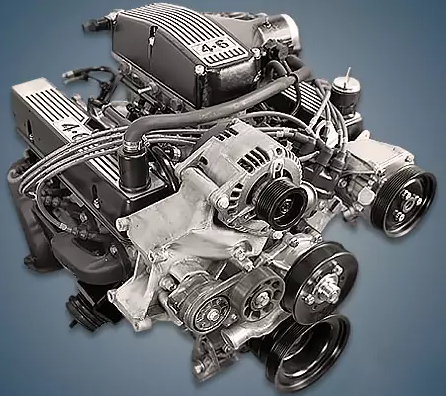
The 42D is part of the Rover V8 series.
Specifications
| Production years | 1994-2004 |
| Displacement, cc | 4552 |
| Fuel system | distributed injection |
| Power output, hp | 218 – 228 |
| Torque output, Nm | 377 – 407 |
| Cylinder block | aluminum V8 |
| Block head | aluminum 16v |
| Cylinder bore, mm | 94 |
| Piston stroke, mm | 82 |
| Compression ratio | 9.35 |
| Features | OHV |
| Hydraulic lifters | yes |
| Timing drive | chain |
| Phase regulator | no |
| Turbocharging | no |
| Recommended engine oil | 5W-40 |
| Engine oil capacity, liter | 5.8 |
| Fuel type | petrol |
| Euro standards | EURO 2 |
| Fuel consumption, L/100 km (for Range Rover II 1998) — city — highway — combined |
22.9 12.4 16.2 |
| Engine lifespan, km | ~180 000 |
The engine was installed on:
- Land Rover Discovery 2 (L318) in 2002 – 2004;
- Land Rover Range Rover 2 (P38A) in 1994 – 2002.
Disadvantages of the Land Rover 46D engine
Up until 1999, sleeves frequently sank and the crankshaft jammed in engines; after that, the block was updated and a small shoulder appeared to support the sleeves; that same year, Bosch Motronic replaced the unreliable GEMS injection system; updated engines after 1999 frequently have microcracks in the block walls; many of these issues are caused by erratic electrical sensors and a gasoline pump.