
From 1994 to 2002, the company produced the Land Rover 42D 4.0-liter gasoline engine, which was fitted in well-known SUVs like the Range Rover II, Defender, and Discovery 2. This unit has multiple versions and is also referred to by the 56D, 57D, and 94D indices.
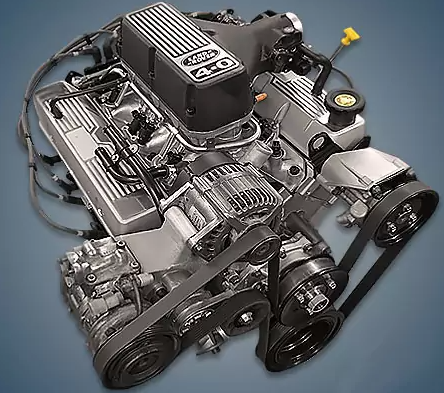
The 46D is part of the Rover V8 series.
Specifications
| Production years | 1994-2002 |
| Displacement, cc | 3946 |
| Fuel system | distributed injection |
| Power output, hp | 185 – 190 |
| Torque output, Nm | 320 – 340 |
| Cylinder block | aluminum V8 |
| Block head | aluminum 16v |
| Cylinder bore, mm | 94 |
| Piston stroke, mm | 71 |
| Compression ratio | 9.35 |
| Features | OHV |
| Hydraulic lifters | yes |
| Timing drive | chain |
| Phase regulator | no |
| Turbocharging | no |
| Recommended engine oil | 5W-40 |
| Engine oil capacity, liter | 5.8 |
| Fuel type | petrol |
| Euro standards | EURO 2 |
| Fuel consumption, L/100 km (for Range Rover II 1996) — city — highway — combined |
22.5 12.6 16.3 |
| Engine lifespan, km | ~200 000 |
The engine was installed on:
- Land Rover Defender 1 (L316) in 1994 – 1998;
- Land Rover Discovery 2 (L318) in 1998 – 2002;
- Land Rover Range Rover 2 (P38A) in 1994 – 2002.
Disadvantages of the Land Rover 42D engine
Engine failure and liner drawdown were widespread issues until 1999.
The cylinder block was then updated, and a collar for the liners was added.
Bosch Motronic replaced the incredibly unreliable GEMS injection system that same year.
Block microcracks are a common problem with updated units made after 1999.
A gasoline pump and erratic electrical sensors cause a lot of problems.