
Since 2013, the 1.5-liter Mazda P5-VPS or SkyActiv-G 1.5 gasoline engine has been manufactured at the plant in Japan. It is fitted to the company’s smallest models, which go by the indexes 2 or Demio and 3 or Axela. This motor has been modified with the P5-VP index for the MX-5 rear-wheel drive model.
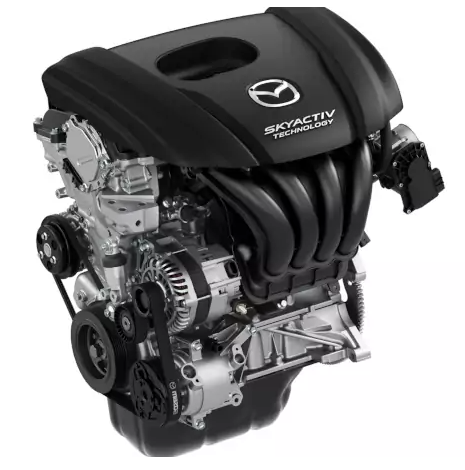
The 1.5-liter Mazda SkyActiv 1.5 engine replaces the out-of-date 1.6 Z6 and is a relatively new engine from the Skyactive series, which generally replaced the MZR. Two versions of the SkyActiv 1.5L are available: one with a compression ratio of 13 and 100 horsepower, and another with a compression ratio of 14 and 120 horsepower. Direct fuel injection and a dual S-VT variable valve timing system on the intake and outlet shafts are features of both versions of the engine. This engine has a lightweight connecting rod and piston group, and the pistons have a unique shape that maximizes combustion efficiency and lowers the risk of detonation.
PE-VPS and PY-VPS engines are also part of the Skyactiv-G family.
The engine was mounted on:
- Mazda 2 DJ since 2014;
- Mazda 3 BM in 2013 – 2019;
- Mazda 3 BP since 2018.
Specifications
| Production years | since 2013 |
| Displacement, cc | 1496 |
| Fuel system | direct injection |
| Power output, hp | 100 – 120 |
| Torque output, Nm | 140 – 150 |
| Cylinder block | aluminum R4 |
| Block head | aluminum 16v |
| Cylinder bore, mm | 74.5 |
| Piston stroke, mm | 85.8 |
| Compression ratio | 13-14 |
| Features | DOHC |
| Hydraulic lifters | yes |
| Timing drive | chain |
| Phase regulator | Dual S-VT |
| Turbocharging | no |
| Recommended engine oil | 0W-20 |
| Engine oil capacity, liter | 3.9 |
| Fuel type | petrol |
| Euro standards | EURO 4/5 |
| Fuel consumption, L/100 km (for Mazda 3 2017) — city — highway — combined |
7.4 4.9 5.8 |
| Engine lifespan, km | ~250 000 |
Disadvantages of the P5-VPS engine
This engine requires high-quality gasoline; injectors are frequently clogged; poor fuel frequently disables ignition coils; lubricant consumption starts to show up in the first kilometers but does not significantly increase with mileage; the ribbed belt may burst due to the wear of the plastic tension roller;
Small oil leaks frequently occur near the engine’s front cover.