
Since 2013, a Japanese company has been assembling the 2.5-liter Mazda PY-VPS or SkyActiv-G 2.5 gasoline engine, which is fitted on well-known models like the 6, CX-5, and CX-8. Motor modifications are available under the PY-RPS and PY-VPR indices in certain markets.
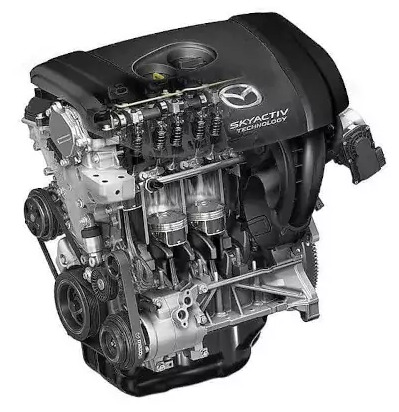
The two-liter version of SkyActive 2.0 was introduced alongside the engine. The engine took the place of the outdated 2.3 and 2.5-liter Ford MZR L-series motors. The motor is extremely modern, just like every engine in this series. Direct fuel injection, a 4-2-1 outlet manifold (spider), a dual S-VT phase change system, a high compression ratio of 14:1, hydraulic lifters, and specially shaped pistons that guarantee ideal fuel combustion throughout the entire stroke.
The P5-VPS and PE-VPS engines are also part of the Skyactiv-G family.
The engine was mounted on:
- Mazda 6 GJ in 2013 – 2016;
- Mazda CX-5 KE in 2013 – 2017;
- Mazda CX-5 KF since 2017;
- Mazda CX-8 KG since 2017.
Specifications
| Production years | 1992-2003 |
| Displacement, cc | 2488 |
| Fuel system | direct injection |
| Power output, hp | 185 – 195 |
| Torque output, Nm | 245 – 255 |
| Cylinder block | aluminum R4 |
| Block head | aluminum 16v |
| Cylinder bore, mm | 89 |
| Piston stroke, mm | 100 |
| Compression ratio | 13-14 |
| Features | DOHC |
| Hydraulic lifters | yes |
| Timing drive | chain |
| Phase regulator | Dual S-VT |
| Turbocharging | no |
| Recommended engine oil | 0W-20 |
| Engine oil capacity, liter | 4.2 |
| Fuel type | petrol |
| Euro standards | EURO 4/5 |
| Fuel consumption, L/100 km (for Mazda CX-5 2015) — city — highway — combined |
9.3 6.1 7.3 |
| Engine lifespan, km | ~320 000 |
The MZR 2.0, which had a compression ratio of 10.0, served as the model for the petrol aspirated Skyactiv-G. At the conclusion of the compression stroke, raising the compression ratio raises the cylinder’s temperature and pressure. Higher power and efficiency are promised, but there is also a significant risk of detonation—the explosive combustion of the air-fuel mixture that causes overheating and piston and ring destruction. For highly accelerated sports engines using detonation-resistant fuel with a high octane number, a compression ratio near 14 is more common. The Skyactiv-G’sdesignhas undergone numerous innovations to enable painless digestion of ordinary 95 gasoline and reduce mechanical losses to increase efficiency.
The purpose of the ion sensors integrated into the ignition coils is to prevent engine detonation. The entire idea is that the motor’s operation guarantees the mixture’s most effective combustion while it is on the verge of detonation. Prior to the use of ionic sensors, which are more sensitive and enable better control over the moment of detonation in each cylinder, the block was monitored by a single, conventional guard. After the mixture ignites, the new sensor uses variations in the ion current in the space between the spark plug electrodes to track detonation. Ions are created when it burns, making the medium conductive. The sensor measures the current flowing between the grounded side electrode and the spark plug’s center electrode after applying voltage to it.
Up to 200 bar of pressure is possible with the new fuel system that uses direct injection! This became essential for correct mixture formation as the cylinder’s pressure increased (previously, Mazda used direct injection primarily for supercharged engines, but the pressure did not exceed 115 bar). This solution produces an engine with high power, efficiency, and environmental friendliness through efficient combustion.
The camshaft drives the high pressure fuel pump as before, but this time it does so from the exhaust. Six-hole nozzles are added to it (for improved fuel atomization). Gasoline also lowers the temperature in the combustion chamber with good evaporation, which lessens the chance of detonation.
Disadvantages of the PY-VPS engine
Owners of vehicles with these engines frequently deal with oil consumption;
Connecting rod bearings frequently need to be replaced when there is a significant decrease in lubrication;
Additionally, the engine dislikes poor-quality fuel, which causes the fuel system to clog quickly and ignition coils to fail;
The ribbed belt may burst as a result of plastic tension roller cracks.