
One of Nissan’s biggest engines is the VQ35. Numerous times, this engine has been named “Best Engine of the Year.” The VQ30DE unit, a member of the initial generation of VQ motors, was superseded by the VQ35.
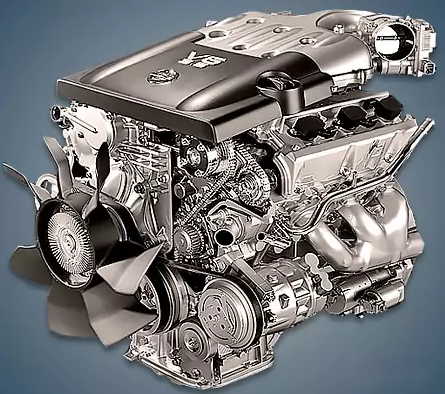
The VQ30 series includes VQ30DE, VQ30DET, VQ30DD, VQ35DE, VQ35DD, VQ35HR, and VQ37VHR.
Since 2000, the 3.5-liter V6 Nissan VQ35DE engine has been assembled at the factories in Iwaki and Decherd and installed in numerous high-end models of the company, most notably the Infiniti. This power unit is referred to as the V4Y index on vehicles sold under the Renault and Samsung brands.
The Japanese company Nissan introduced what is arguably its most well-known V6 engine in 2000. This motor has a timing chain drive, two DOHC heads, and an aluminum cylinder block. A variable valve timing system (CVTCS) is installed on the engine’s intake camshafts. The motor’s features include a nylon intake manifold, forged crankshaft and connecting rods, molybdenum-coated pistons, and mirror-finished rubbing components. However, the valves need to be adjusted on a regular basis and hydraulic compensators are not offered here.
The Rev-Up index was used to modify the 350Z and Infiniti G35 between 2005 and 2006. Evil camshafts, a short-stroke intake manifold, a more effective oil pump, reinforced connecting rods, and CVTCS phase regulators on the intake and exhaust set this version apart. Its maximum power has increased from 280–285 horsepower to 300–305 horsepower as a result of all of this. A particularly eco-friendly version of the VQ35DE NEO, or Nissan Ecology Oriented, was installed on the Samsung SM7.
Specifications
| Start of production | 2000 |
| Displacement, cc | 3498 |
| Fuel system | injector |
| Power output, hp | 215 – 305 |
| Torque output, Nm | 315 – 375 |
| Cylinder block | aluminum V6 |
| Block head | aluminum 24v |
| Cylinder bore, mm | 95.5 |
| Piston stroke, mm | 81.4 |
| Compression ratio | 10.3 |
| Hydraulic lifters | no |
| Timing drive | chain |
| Phase regulator | CVTCS |
| Turbocharging | no |
| Recommended engine oil | 5W-30, 5W-40 |
| Engine oil capacity, liter | 4.7 |
| Fuel type | petrol |
| Euro standards | EURO 4/5 |
| Fuel consumption, L/100 km (for Nissan Murano 2017) — city — highway — combined |
13.8 8.0 10.2 |
| Engine lifespan, km | ~400 000 |
| Weight, kg | 180 |
The engine was installed on:
- Infiniti G35 3 (V35), I35 3 (A33), M35 3 (Y50), FX35 1 (S50), JX35 1 (L50), QX60 1 (L50), QX4 1 (R50);
- Nissan 350Z 5 (Z33), Altima 3 (L31), Altima 4 (L32), Altima 5 (L33), Cefiro 4 (J31), Elgrand 1 (E50), Elgrand 2 (E51), Elgrand 3 (E52), Maxima 5 (A33), Maxima 6 (A34), Maxima 7 (A35), Maxima 8 (A36), Murano 1 (Z50), Murano 2 (Z51), Murano 3 (Z52), Presage 2 (U31), Pathfinder 2 (R50), Pathfinder 4 (R52), Quest 3 (V42), Quest 4 (RE52), Skyline 11 (V35), Stagea 2 (M35), Teana 1 (J31), Teana 2 (J32), Teana 3 (L33);
- Renault Espace 4 (J81), Laguna 3 Coupe (D91), Latitude 1 (L70), Vel Satis 1 (B73) as V4Y;
- Samsung SM7 1 (EX2), SM7 2 (L47) as V4Y.
Disadvantages of the VQ35DE engine
Although this unit has a lot of resources and is very dependable, it frequently uses oil. The cause is either scuffing from crumbs from collapsing catalysts getting into the cylinders or coking from prolonged driving at low speeds, like in traffic jams.
The cardboard gaskets of the oil channels beneath the front cover are the weak point; eventually, they are squeezed out, the pressure decreases, and phase regulator errors occur. The lubrication level will fall below a critical level if you ignore it for an extended period of time.
The fifth or sixth cylinders frequently overheat due to the poorly designed cooling system. Oil typically seeps into the spark plug wells as a result of the valve cover seals drying out rather quickly.
The cooling fan’s unreliable viscous coupling and the need to periodically adjust the valves because there are no hydraulic compensators are additional weak points.