
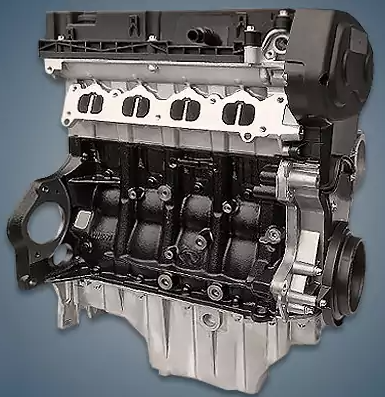
From 2008 to 2013, the Opel A16LET or LLU 1.6-liter turbo engine was assembled in Hungary and fitted to charged versions of well-known models like the Astra and Insignia. A16LEL, A16LER, and A16LES are additional versions in terms of power.
A12XER, A14XER, A14NET, A16XER, A16XHT, and A18XER are all part of the A10 line.
The LLU turbo engine, designed for the company’s charged European models and referred to as the A16LET index, debuted in 2008 as part of the third generation of GM Family 1 vehicles. Distributed injection, a cast-iron block with a closed cooling jacket, an aluminum 16-valve head without hydraulic lifters, a timing belt drive, a DCVCP-type phase control system on the intake and exhaust shafts, and a BorgWarner K03 turbine are all structural features.
This engine, which is part of a whole line of supercharged power units that also includes engines like the A16LEL for 150 horsepower and 210 Nm, A16LER for 192 horsepower and 230 (266) Nm, and A16LES for 209 horsepower and 250 (280) Nm, is essentially the replacement for the similar Z16LET turbo engine from Astra H.
The engine was mounted on:
- Opel Astra J (P10) in 2009 – 2012;
- Opel Insignia A (G09) in 2008 – 2013.
Specifications
| Production years | 2008-2013 |
| Displacement, cc | 1598 |
| Fuel system | distributed injection |
| Power output, hp | 180 |
| Torque output, Nm | 230 |
| Cylinder block | cast iron R4 |
| Block head | aluminum 16v |
| Cylinder bore, mm | 79 |
| Piston stroke, mm | 81.5 |
| Compression ratio | 8.8 |
| Hydraulic lifters | no |
| Timing drive | belt |
| Phase regulator | DCVCP |
| Turbocharging | BorgWarner K03 |
| Recommended engine oil | 5W-30, 5W-40 |
| Engine oil capacity, liter | 4.5 |
| Fuel type | petrol |
| Euro standards | EURO 5 |
| Fuel consumption, L/100 km (for Opel Astra 2010) — city — highway — combined |
10.3 5.9 7.5 |
| Engine lifespan, km | ~200 000 |
| Weight, kg | 130 |
Disadvantages of the A16LET engine
The most well-known issue with this engine is the fourth cylinder’s piston destruction, which could be caused by the pistons’ poor quality, detonation from subpar fuel, or inadequate cooling of the cylinder block’s rear, though the exact cause is unknown.
This engine’s short-lived plastic pipes frequently burst, and unaccounted-for air disrupts the flow meter’s functioning and causes the engine to run unsteadily. Strong leaks and cracks in coolant pipes are common.
Although the BorgWarner K03 turbocharger is very dependable and has a long lifespan, it is frequently let down by an electrovacuum wastegate control valve and a membrane in the bypass valve that keeps bursting.
An unreliable ECU that destroys solder, an ignition module that constantly cracks, a current heat exchanger, and a fragile crankcase ventilation membrane are some of the motor’s other weak points. Additionally, a gas flow happens when the cylinder head gasket between the cylinders frequently breaks.