
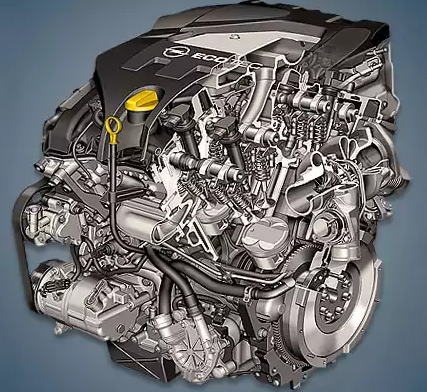
The Opel Z28NET, a 2.8-liter V6 turbo engine built in Australia between 2005 and 2008, was fitted to the Opel Vectra and Signum until it was replaced by the Euro 5 unit A28NET. Under its own B284L index, Saab vehicles had the same engine installed.
The engines Z20LET, Z22SE, Z22YH, Z24SED, and Z32SE are also members of the Z family.
GM needed a strong engine for its European models in the early 2000s, and in keeping with the long-standing custom, the Australian division of Holden was given the task. This is a traditional V6 engine by design, featuring a timing chain, intake phase shifters, two cylinder heads with four valves each, an aluminum block, and cast-iron sleeves. This is where fuel injection is distributed, and supercharging is handled by the Mitsubishi TD04 Twin-Scroll turbine. The valve clearance does not need to be adjusted because hydraulic compensators are included.
There was a Z28NEL derated to 230 hp and 330 Nm without a phase control system, as well as a more potent Z28NEH with 280 hp, in addition to the standard Z28NET with 250 hp.
On what was the engine installed:
- Opel Signum A (Z03) in 2005 – 2008;
- Opel Vectra C (Z02) in 2005 – 2008.
Specifications
| Production years | 2005-2008 |
| Displacement, cc | 2792 |
| Fuel system | distributed injection |
| Power output, hp | 250 |
| Torque output, Nm | 350 |
| Cylinder block | aluminum V6 |
| Block head | aluminum 24v |
| Cylinder bore, mm | 89 |
| Piston stroke, mm | 74.8 |
| Compression ratio | 9.5 |
| Hydraulic lifters | yes |
| Timing drive | chain |
| Phase regulator | yes |
| Turbocharging | yes |
| Recommended engine oil | 5W-30 |
| Engine oil capacity, liter | 6.0 |
| Fuel type | petrol |
| Euro standards | EURO 4 |
| Fuel consumption, L/100 km (for Opel Vectra 2007) — city — highway — combined |
17.1 7.3 10.9 |
| Engine lifespan, km | ~300 000 |
| Weight, kg | 215 |
Disadvantages of the Z28NET engine
Three Morse leaf chains with a modest resource are used in the timing drive; they are frequently extended up to 100,000 km, and replacing them is challenging and costly.
Keep an eye on the cooling system’s condition because this unit overheats easily. Additionally, the thermostat is unreliable and antifreeze leaks frequently.
The thin-walled air duct that connects the intake manifold to the air filter frays easily. The engine begins to operate erratically due to unaccounted-for air.
Only the wastegate membrane and bypass are problematic; the turbine itself is dependable. Their failure results in either too little or too much boost pressure.
An electronic engine control unit, a gasoline pump, an oil pressure sensor, a power steering pump, and an electric vacuum brake booster are additional weak points of this motor.