
The Peugeot DW10TD 2.0-liter 8-valve engine is part of a broad range of 2.0 HDi diesel engines. Three versions of this power unit were manufactured between 1999 and 2006: RHY for passenger car models, RHX for minivans, and RHV for minibuses.
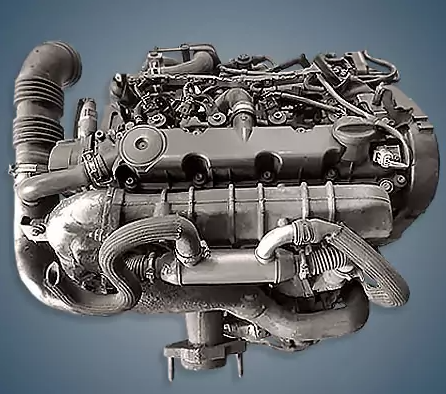
DW10TD, DW10ATED, DW10ATED4, DW10BTED4, DW10CTED4, DW10DTED4, DW10FCTED4, and DW10FDTED4 are all part of the DW10 line.
DW10TD motor apparatus:
- Cast iron in-line 4-cylinder block without liners;
- Aluminum 8-valve cylinder head with 1 camshaft;
- Fuel system Common Rail Bosch CP1 or Siemens SDI 801;
- Turbocharger here without controlled geometry and intercooler;
- Timing gear drive here with a toothed belt;
- There are hydraulic lifters, valve adjustment is not needed;
- The engine does not use a FAP filter, the flywheel is only single-mass.
Specifications
| Production years | 1999-2006 |
| Displacement, cc | 1997 |
| Fuel system | Common Rail |
| Power output, hp | 85 – 95 |
| Torque output, Nm | 160 – 220 |
| Cylinder block | cast iron R4 |
| Block head | aluminum 8v |
| Cylinder bore, mm | 85 |
| Piston stroke, mm | 88 |
| Compression ratio | 18.0 |
| Hydraulic lifters | yes |
| Timing drive | belt |
| Phase regulator | no |
| Turbocharging | yes |
| Recommended engine oil | 5W-30, 5W-40 |
| Engine oil capacity, liter | 5.25 |
| Fuel type | diesel |
| Euro standards | EURO 3/4 |
| Fuel consumption, L/100 km (for Peugeot 406 2003) — city — highway — combined |
7.7 4.5 5.7 |
| Engine lifespan, km | ~500 000 |
| Weight, kg | 160 |
The engine was installed on:
- Peugeot 206 I (T1) in 1999 – 2006;
- Peugeot 306 I (N3/N5) in 1999 – 2001;
- Peugeot 307 I (T5/T6) in 2001 – 2004;
- Peugeot 406 I (D8/D9) in 2000 – 2004;
- Peugeot Partner I (M49/M59) in 2001 – 2005;
- Citroen C5 I (X3/X4) in 2002 – 2004;
- Citroen Berlingo I (M49/M59) in 2001 – 2005;
- Citroen Xsara I (N6/N7) in 1999 – 2005;
- Citroen Xsara Picasso I (N68) in 2000 – 2005;
- Citroen Xantia I (X1/X2) in 1999 – 2001;
- Suzuki Vitara in 2002 – 2004.
Disadvantages of the DW10TD engine
The crankshaft damper pulley frequently failed in the early years of production. Its resource did not go beyond 30 to 50 thousand kilometers for the majority of owners.
A clogged pressure regulator mesh has caused thrust failures for many. While some drivers prefer to remove it immediately, others prefer to do the purge.
The booster electric pump in the tank needs to be changed frequently. When there is little diesel in the fuel tank, try not to drive for extended periods of time.
Tandem pump failure is a defining feature of the Siemens CR system. The injection pump must be disassembled in a specialized workshop in order to be repaired.
The nozzles themselves are dependable, but when they are disassembled for cleaning, there is a chance that they will break off. Consequently, you will need to take off the cylinder head and use a coordinate machine to drill them.