
Since 2010, the 1.6-liter Peugeot EC5 or NFP engine has been manufactured in China and Brazil. It is found in the company’s popular low-cost models, including the C-Elysee, 301, and 408. This engine features a Flexible-fuel EC5F and is essentially a modernization of the TU5JP4 unit.
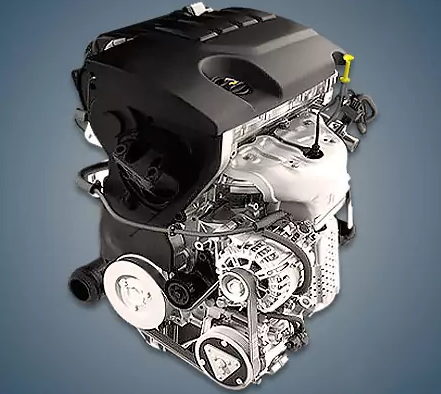
The ET/EC family of engines includes the ET3J4, EC5, and EC8.
The Peugeot company debuted a low-cost engine for the market in developing nations in 2010. It was based on the TU5JP4 unit and was unique in that it had a phase regulator at the intake. Other than that, it is a similar engine with a timing belt drive, an aluminum 16-valve block head with hydraulic lifters, a cast-iron block, and distributed fuel injection. Here, the intake manifold is made of plastic, and the ignition coils are constructed in a single unit.
This power unit has spread to Brazil in addition to China and Russia, and as a result, a flexible-fuel version known as the EC5F or NFN index was created.
The engine was mounted on:
- Citroen C-Elysee I (R31) since 2012;
- Citroen C4 Sedan II (B7) since 2012;
- Peugeot 301 I (M33) since 2012;
- Peugeot 408 I (T73) since 2014.
Specifications
| Production years | since 2010 |
| Displacement, cc | 1587 |
| Fuel system | distributed injection |
| Power output, hp | 115 |
| Torque output, Nm | 150 |
| Cylinder block | cast iron R4 |
| Block head | aluminum 16v |
| Cylinder bore, mm | 78.5 |
| Piston stroke, mm | 82 |
| Compression ratio | 10.8 |
| Features | no |
| Hydraulic lifters | yes |
| Timing drive | belt |
| Turbocharging | no |
| Recommended engine oil | 5W-30, 5W-40 |
| Engine oil capacity, liter | 4.2 |
| Fuel type | petrol |
| Euro standards | EURO 4/5 |
| Fuel consumption, L/100 km (for Peugeot 408 2017) — city — highway — combined |
9.7 5.8 7.1 |
| Engine lifespan, km | ~400 000 |
| Weight, kg | 124 |
Disadvantages of the Peugeot EC5 engine
The most well-known engine issue is a weak catalytic converter, which can break down after 100–150 thousand kilometers if poor fuel is added to the tank. Oil consumption typically reaches 1.5 liters per 1000 kilometers after the catalyst is removed.
Because the rings in this unit are thinner and lie faster than those in the TU5 engine, lubrication consumption may also be seen with a fully functional catalyst.
The timing belt is supposed to be changed every 120,000 kilometers, but it doesn’t always last that long, and following the dealer’s advice may cause it to break or cause the valves to bend.
Additionally, contamination of the throttle assembly frequently results in floating revolutions, and in this case, unreliable ignition coils are combined into a single, costly unit.