
Popular models like the Golf 3, Vento, Passat B3, and B4 were equipped with the 1.8-liter Volkswagen AAM or Golf 3 1.8 single injection engine from 1990 until 1998. This power unit was upgraded and had its own ANN index.
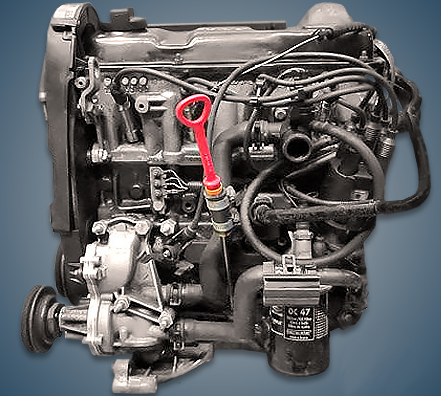
RP, AAM, ABS, ADZ, PF, ADR, ARG, AEB, and ANB are all part of the EA827 1.8l series.
Specifications
| Production years | 1990-1998 |
| Displacement, cc | 1781 |
| Fuel system | Mono-Motronic |
| Power output, hp | 75 |
| Torque output, Nm | 140 |
| Cylinder block | cast iron R4 |
| Block head | aluminum 8v |
| Cylinder bore, mm | 81 |
| Piston stroke, mm | 86.4 |
| Compression ratio | 9.0 |
| Features | SOHC |
| Hydraulic lifters | yes |
| Timing drive | belt |
| Phase regulator | no |
| Turbocharging | no |
| Recommended engine oil | 5W-40 |
| Engine oil capacity, liter | 3.8 |
| Fuel type | petrol |
| Euro standards | EURO 1 |
| Fuel consumption, L/100 km (for VW Golf 1993) — city — highway — combined |
9.5 5.5 7.5 |
| Engine lifespan, km | ~320 000 |
The engine was installed on:
- Volkswagen Golf 3 (1H) in 1991 – 1997;
- Volkswagen Passat B3 (31) in 1990 – 1993; Passat B4 (3A) in 1993 – 1996;
- Volkswagen Vento 1 (1H) in 1992 – 1998.
Disadvantages of the VW AAM engine
This engine is incredibly dependable in terms of iron, and when the belt breaks, it doesn’t even bend the valves.
Suction from a ripped single-injection cushion is the primary cause of the issues.
Here, the throttle position potentiometer frequently malfunctions as well.
The idle speed controller, sensors, and ignition system components all have limited resources.
Fuel consumption starts to rise dramatically when a lambda probe or its wiring burns out.