
From 1991 to 1999, the third Golf, Vento, Passat, B3 and B4 bodies, and a few other Seat models were equipped with the 1.8-liter Volkswagen ABS mono-injection engine. In many automotive markets, this unit was once quite common.
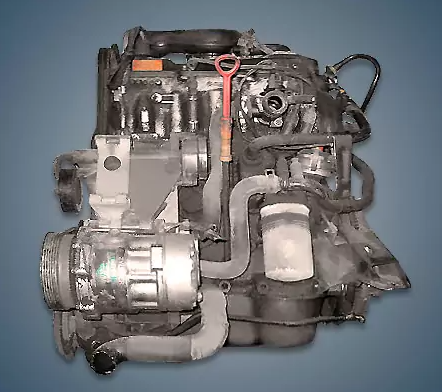
RP, AAM, ABS, ADZ, PF, ADR, ARG, AEB, and ANB are all part of the EA827 1.8l series.
Specifications
| Production years | 1991-1999 |
| Displacement, cc | 1781 |
| Fuel system | single injection |
| Power output, hp | 90 |
| Torque output, Nm | 145 |
| Cylinder block | cast iron R4 |
| Block head | aluminum 8v |
| Cylinder bore, mm | 81 |
| Piston stroke, mm | 86.4 |
| Compression ratio | 10.0 |
| Features | SOHC |
| Hydraulic lifters | yes |
| Timing drive | belt |
| Phase regulator | no |
| Turbocharging | no |
| Recommended engine oil | 5W-40 |
| Engine oil capacity, liter | 3.8 |
| Fuel type | petrol |
| Euro standards | EURO 1 |
| Fuel consumption, L/100 km (for VW Passat B3 1992) — city — highway — combined |
11.0 6.8 8.3 |
| Engine lifespan, km | ~300 000 |
The engine was installed on:
- Volkswagen Golf 3 (1H) in 1991 – 1999;
- Volkswagen Passat B3 (31) in 1991 – 1993; Passat B4 (3A) in 1993 – 1994;
- Volkswagen Vento 1 (1H) in 1992 – 1994;
- Seat Cordoba 1 (6K) in 1993 – 1999;
- Seat Toledo 1 (1L) in 1993 – 1999.
Disadvantages of the VW ABS engine
The majority of owners’ issues are brought on by an unpredictable mono-injection system;
Because of air leaks or dirt on the throttle, engine speeds typically float.
Here, the resources of an antifreeze temperature sensor and a lambda probe are low;
Additionally, this engine is well-known for its frequent coolant and lubricant leaks; on extended runs, an oil burn develops as a result of ring or cap wear.