
The fourth generation Golf model and its equivalents, the Bora, Octavia, Toledo, and Leon, were equipped with the 1.4-liter 16-valve Volkswagen AXP engine, which was manufactured between 2000 and 2004. A comparable AKQ motor was once replaced by this power unit before BCA took its place.
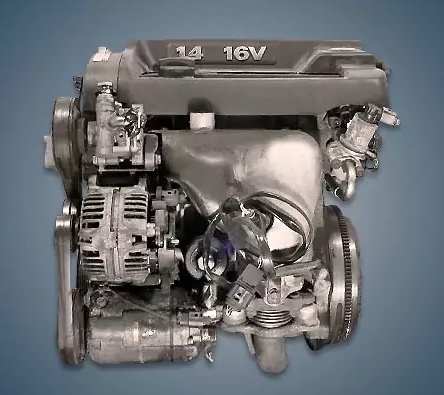
AEX, AKQ, AXP, BBY, BCA, BUD, CGGA, and CGGB are all part of the EA111-1.4 series.
Specifications
| Production years | 2000-2004 |
| Displacement, cc | 1390 |
| Fuel system | injector |
| Power output, hp | 75 |
| Torque output, Nm | 126 |
| Cylinder block | aluminum R4 |
| Block head | aluminum 16v |
| Cylinder bore, mm | 76.5 |
| Piston stroke, mm | 75.6 |
| Compression ratio | 10.5 |
| Features | DOHC |
| Hydraulic lifters | yes |
| Timing drive | belt |
| Phase regulator | no |
| Turbocharging | no |
| Recommended engine oil | 5W-30 |
| Engine oil capacity, liter | 3.2 |
| Fuel type | petrol |
| Euro standards | EURO 3 |
| Fuel consumption, L/100 km (for VW Golf 4 2000) — city — highway — combined |
8.4 5.3 6.4 |
| Engine lifespan, km | ~260 000 |
The engine was installed on:
- Volkswagen Bora 1 (1J) in 2000 – 2004;
- Volkswagen Golf 4 (1J) in 2000 – 2003;
- Seat Leon 1 (1M) in 2000 – 2004;
- Seat Toledo 2 (1M) in 2000 – 2004;
- Skoda Octavia 1 (1U) in 2000 – 2004.
Disadvantages of the VW AXP engine
Despite having a few flaws, this power unit is thought to be fairly dependable.
Because the crankcase ventilation freezes during the winter, oil frequently seeps out through the dipstick.
Furthermore, grease frequently seeps from other areas, particularly beneath the valve cover.
When timing belts break, the valves bend here, and replacing a set of belts is very costly.
On trifles, we observe the low resource of the coolant temperature sensor and the throttle’s ongoing contamination.