
Many of the company’s well-known models, including the Tiguan, Golf 6, and Passat B6, were equipped with the 2.0-liter Volkswagen CBAB 2.0 TDI diesel engine, which was produced between 2007 and 2015. This is a very well-liked diesel.
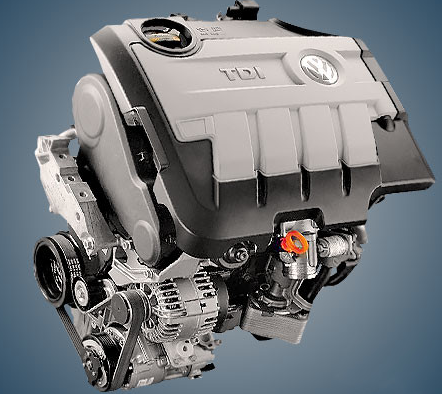
CAYC, CAAC, CAGA, CAHA, CBAB, CFCA, CFGB, CLCA, CLJA, CKTB, CFHC, and CKUB are also included in the EA189 series.
A 2.0-liter power unit under the CBAB index is one of the Common Rail EA189 diesel engines that Volkswagen unveiled in 2007. A timing belt, an aluminum 16-valve cylinder head with hydraulic lifters, a cast-iron block, a fuel system with a Bosch CP4 single-plunger pump, and piezo injectors are all part of the design. Supercharging is accomplished by the KKK BV43 turbocharger with a variable geometry vacuum drive.
This diesel engine also has an electrically operated EGR valve, a balancer block with an oil pump, and an intake manifold with swirl flaps.
Specifications
| Production years | 2007-2015 |
| Displacement, cc | 1968 |
| Fuel system | Common Rail |
| Power output, hp | 140 |
| Torque output, Nm | 320 |
| Cylinder block | cast iron R4 |
| Block head | aluminum 16v |
| Cylinder bore, mm | 81 |
| Piston stroke, mm | 95.5 |
| Compression ratio | 16.5 |
| Hydraulic lifters | yes |
| Timing drive | belt |
| Phase regulator | no |
| Turbocharging | KKK BV43 |
| Recommended engine oil | 5W-30, 5W-40 |
| Engine oil capacity, liter | 4.7 |
| Fuel type | diesel |
| Euro standards | EURO 4/5 |
| Fuel consumption, L/100 km (for Volkswagen Passat B6 2009) — city — highway — combined |
7.2 4.6 5.6 |
| Engine lifespan, km | ~400 000 |
| Weight, kg | 165 |
The engine was installed on:
- Audi A3 2 (8P) in 2008 – 2013;
- Volkswagen Golf 6 (5K) in 2008 – 2013;
- Volkswagen Eos 1 (1F) in 2008 – 2015;
- Volkswagen Passat B6 (3C) in 2008 – 2010; Passat B7 (36) in 2010 – 2014;
- Volkswagen Passat CC (35) in 2008 – 2011;
- Volkswagen Tiguan 1 (5N) in 2007 – 2015.
Disadvantages of the VW CBAB engine
This power unit has an oil pump that is powered by an excessively short hex key in addition to a block of balancers. Up to 150,000 kilometers, it shuts off the oil pump and reduces the system’s lubricating pressure. This issue was resolved in November 2009 when the ill-fated hexagon’s length was extended.
Although the Bosch CP4 fuel system is thought to be very dependable, it has some drawbacks. For example, if it is not properly maintained, the fuel pump pusher roller will turn across the cam, causing the pump to start driving chips. Additionally, the fuel pressure regulator frequently wedges here, and the piezo injectors’ resource is immediately impacted by the use of inferior diesel fuel.
The BorgWarner, also known as the KKK BV43 turbine, is not a problem; instead, the membrane cracks in a vacuum geometry change actuator. Occasionally, the vacuum tube of the turbine control valve bursts or the valve itself fails.
Contamination of the EGR valve and intake manifold swirl flaps, which also have an unreliable mechanism, causes a lot of problems, just like in any modern diesel engine. Additionally, the oil separator membrane in the valve cover needs to be updated on a regular basis.