
The D9A is a fuel-optimized turbo engine that has been electronically optimized. These factors make the motors very cost-effective and efficient. This family of engines achieves maximum power at low rpm, saving consumables, lowering noise levels, and extending the mechanism’s lifespan.
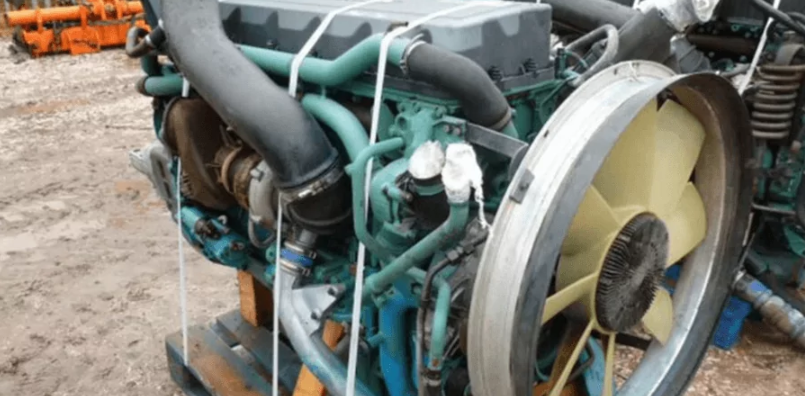
The larger D12D and the D9A380 share the same fundamental idea. It has a full cylinder head cover, individual unit injectors, four valves per cylinder, and an overhead camshaft. A relief valve on the turbocharger permits high discharge and power take-off pressures. Volvo’s electronic engine management system completely controls engine operation, which helps to reduce emissions and fuel consumption.
Additionally, the system has a wide range of diagnostic and troubleshooting features. The high pressure produced by the turbocharger and the engine’s high compression ratio, along with extremely accurate and well-controlled injection via unit injectors, enable extremely efficient combustion.
Engine manual Volvo D9A380 (in spanish)
Specifications
| Engine’s type | diesel |
| Production years | 09.2001 |
| Power output, kW at rpm | 279 at 1900 |
| Power output, hp at rpm | 380 at 1900 |
| Displacement, cc | 9364 |
| Number of cylinders | 6 |
| Valves | 24 |
| Torque output, Nm / rpm | 1700 at 1200-1400 |
| Compression ratio | 18.5:1 |
| Cylinder bore, mm | 120 |
| Piston stroke, mm | 138 |
| Crankshaft bearings | 7 |
| Configuration | inline |
| Fuel type | diesel |
| Fuel system | direct injection |
| Turbine | turbo / charge air cooler |
| Euro standards | Euro 3 |
| Cylinder head | SOHC/OHC |
| Timing mechanism | spur gear |
| Timing | rocker arm |
| Cooling | water |
The features of the D9A380 are as follows:
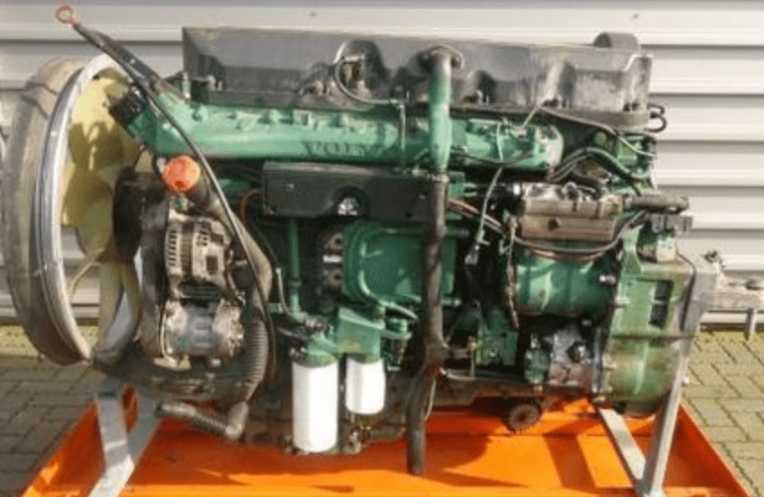
- precise fuel injection and electronic engine management (EMS) to reduce fuel consumption and exhaust emissions;
- electronic management of fuel injection through unit injectors positioned vertically in the center;
- electronic oil level sensor that sends a signal to the driver information graphic display;
- maximum torque across a broad range of crankshaft speeds guarantees efficient driving and minimal fuel usage;
- excellent braking effect when using a VEB retarder;
- engine-driven rear power takeoff via a flange or direct hydraulic pump drive.