
The second Golf or Jetta, the Passat B3, and the Seat Toledo all had the 1.8-liter Volkswagen RP mono-injection engine, which was manufactured between 1986 and 1993. Two injection types—Mono-Jetronic and Mono-Motronic—were added to the unit.
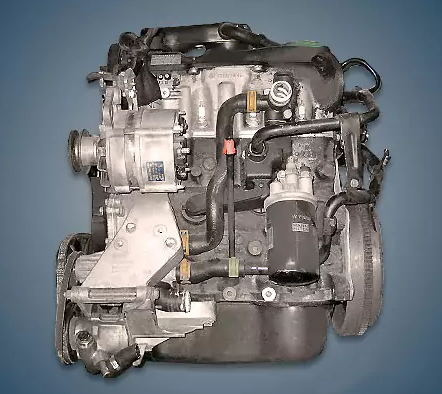
RP, AAM, ABS, ADZ, PF, ADR, ARG, AEB, and ANB are all part of the EA827 1.8l series.
Specifications
| Production years | 1986-1993 |
| Displacement, cc | 1781 |
| Fuel system | single injection |
| Power output, hp | 90 |
| Torque output, Nm | 142 |
| Cylinder block | cast iron R4 |
| Block head | aluminum 8v |
| Cylinder bore, mm | 81 |
| Piston stroke, mm | 86.4 |
| Compression ratio | 9.0 |
| Features | SOHC |
| Hydraulic lifters | yes |
| Timing drive | belt |
| Phase regulator | no |
| Turbocharging | no |
| Recommended engine oil | 5W-40 |
| Engine oil capacity, liter | 3.8 |
| Fuel type | petrol |
| Euro standards | EURO 1 |
| Fuel consumption, L/100 km (for VW Passat 1990) — city — highway — combined |
11.0 7.6 8.8 |
| Engine lifespan, km | ~350 000 |
The engine was installed on:
- Volkswagen Golf 2 (1G) in 1987 – 1992;
- Volkswagen Jetta 2 (1G) in 1986 – 1991;
- Volkswagen Passat B3 (31) in 1988 – 1991;
- Seat Toledo 1 (1L) in 1991 – 1993.
Disadvantages of the VW RP engine
The mono injection system’s unpredictability is responsible for the majority of this engine’s issues.
Air leaks or sensor malfunctions are typically the cause of the motor’s erratic operation.
Ignition system problems, such as those involving the distributor or wires, rank second.
Hydraulic lifters are frequently replaced in order to reduce oil service costs.
Oil consumption frequently manifests after 200,000 kilometers because of clogged piston rings.