
Overview & Design Features
The Acura J37A1 is a 3.7-liter (3664 cc) naturally aspirated, SOHC V6 gasoline engine, a prominent member of Honda’s J-series engine family. Manufactured by Honda Motor Co., Ltd., it represents a peak evolution of the J-series, offering a robust balance of power, refinement, and efficiency within its era. Primarily deployed in Acura’s larger SUVs and performance-oriented sedans, the J37A1 distinguished itself as a powerful, high-displacement V6 engine designed for premium vehicle applications.
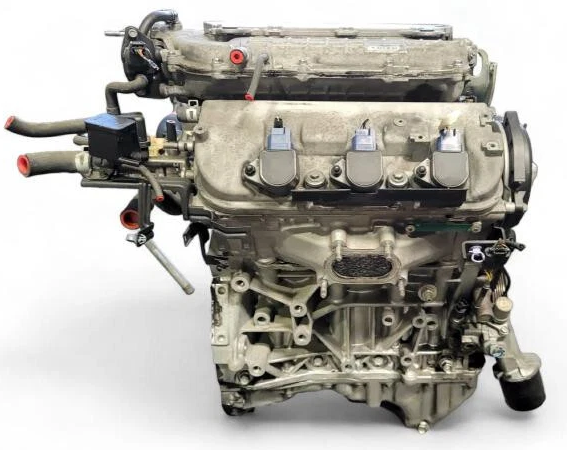
Engineered with an all-aluminum block and cylinder heads, the J37A1 utilizes a 60-degree V-angle for optimal balance and packaging. It features a single overhead camshaft (SOHC) design per cylinder bank, actuating four valves per cylinder. Honda’s proprietary i-VTEC (intelligent Variable Valve Timing and Lift Electronic Control) system is applied to the intake valves, optimizing valve lift, duration, and timing for enhanced power output and fuel efficiency across the RPM range. Fuel delivery is managed by a multi-point port fuel injection (PFI) system, complemented by a drive-by-wire electronic throttle control for precise response. Notably, the J37A1 incorporates Variable Cylinder Management (VCM) technology in certain applications, allowing the engine to operate on three or four cylinders under light load conditions to improve fuel economy.
The J37A1 engine was specifically deployed in several key Acura models. It powered the second-generation Acura MDX (2007-2013) and the unique Acura ZDX (2010-2013) crossover, where it delivered 300 horsepower. Other 3.7L J-series variants, such as the J37A2 and J37A4 (found in the Acura RL and TL SH-AWD, respectively), shared the displacement but often featured different tuning or specific component configurations without VCM.
Technical Specifications
| Specification | Value |
|---|---|
| Displacement (cc) | 3664 |
| Max Power (hp (kW) @ RPM) | 300 hp (224 kW) @ 6300 RPM |
| Max Torque (Nm (kg*m) @ RPM) | 370 Nm (37.7 kg*m) @ 5000 RPM |
| Fuel Type | Premium Unleaded (91+ RON recommended) |
| Fuel Consumption (l/100 km) | ~13.1 (Combined, specific to MDX AWD) |
| Engine Type | Naturally Aspirated V6, SOHC, i-VTEC, PFI, VCM |
| Compression Ratio | 11.2:1 |
| Cylinder Bore (mm) | 90.0 |
| Piston Stroke (mm) | 96.0 |
| Valvetrain | SOHC, 4 valves per cylinder with i-VTEC (intake) |
| Valves per Cylinder | 4 |
| Additional Info | Variable Cylinder Management (VCM), Drive-by-Wire throttle, Electronic Ignition |
Common Problems & Reliability
- Oil Consumption due to VCM: The J37A1, particularly in its MDX and ZDX applications, utilizes Variable Cylinder Management (VCM). This system, designed to improve fuel economy by deactivating cylinders, can lead to increased oil consumption and potential piston ring issues over time. Fouled spark plugs and catalytic converter degradation are also known side effects when VCM is not functioning optimally or if the engine experiences prolonged oil consumption. Solutions often involve more frequent oil changes, VCM disabler modules, or, in severe cases, piston ring replacement.
- Timing Belt Service Requirement: As a belt-driven engine, the J37A1 requires periodic timing belt replacement. Failure to adhere to this critical service interval can result in catastrophic engine damage if the belt breaks. The water pump, timing belt tensioner, and idler pulleys are typically replaced concurrently.
- Power Steering Pump Leaks: While not a direct engine component defect, leaks from the power steering pump and associated high-pressure hoses are a common issue observed across many Acura and Honda models of this era, including those equipped with the J37A1. This typically manifests as fluid drips or groaning noises during steering input.
Despite these known issues, the J37A1 is generally considered a highly reliable engine. With diligent maintenance, particularly addressing the VCM-related concerns and adhering to the timing belt schedule, the J37A1 can realistically achieve a service life exceeding 200,000 miles (approximately 320,000 km) before requiring a major overhaul.
Maintenance Tips & Service Schedule
- Engine Oil & Filter: Use a full synthetic 0W-20 motor oil meeting API SN or newer specifications. Perform oil and filter changes every 5,000 to 7,500 miles (8,000 to 12,000 km) or every 6 months, whichever comes first. Given the potential for VCM-related oil consumption, regular monitoring of oil levels between changes is highly recommended.
- Spark Plugs: Replace iridium-tipped spark plugs every 105,000 miles (168,000 km). Ensure proper torque during installation to prevent thread damage.
- Timing Belt & Water Pump: This is a critical service due every 105,000 miles (168,000 km) or 7 years, whichever occurs first. The service should include replacing the timing belt, water pump, timing belt tensioner, and idler pulleys.
- Coolant Flush: Drain and refill the cooling system with Honda Type 2 long-life coolant. The initial change is recommended at 120,000 miles (192,000 km) or 10 years, then every 60,000 miles (96,000 km) or 5 years thereafter.
- Transmission Fluid: For optimal automatic transmission longevity, perform a drain and fill of the transmission fluid every 30,000 to 60,000 miles (48,000 to 96,000 km) depending on driving conditions (e.g., heavy towing or city driving on the lower end). Use genuine Honda DW-1 ATF.
- Air Filter: Inspect the engine air filter at every oil change and replace as needed, typically every 15,000-30,000 miles (24,000-48,000 km).
Conclusion
The Acura J37A1 engine stands as a robust and powerful V6, offering strong performance and generally high reliability for a used vehicle buyer. While the Variable Cylinder Management system in some applications can contribute to oil consumption over time, this issue is manageable with proactive maintenance and monitoring. Adherence to the prescribed timing belt service and general fluid changes ensures a long operational life. For those considering an Acura MDX or ZDX equipped with the J37A1, it remains a safe and reliable choice, provided its maintenance history is sound and any VCM-related concerns have been addressed or are properly managed.