
From 2008 to 2018, the company’s factories assembled the 2.0-liter Audi CCTA 2.0 TFSI engine, which was installed on nearly all of the German company’s models for the US and Canadian markets. Out of all the first generation EA888 engines, this power unit was manufactured for the longest.
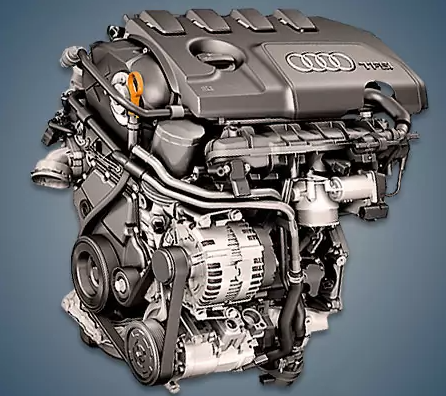
The EA888 gen1 series includes: BYT, BZB, CABA, CABB, CABD, CAWA, CAWB, CBFA, CCTA, CCTB.
Specifications
| Production years | 2008-2018 |
| Displacement, cc | 1984 |
| Fuel system | direct injection |
| Power output, hp | 200 |
| Torque output, Nm | 280 |
| Cylinder block | cast iron R4 |
| Block head | aluminum 16v |
| Cylinder bore, mm | 82.5 |
| Piston stroke, mm | 92.8 |
| Compression ratio | 9.6 |
| Features | DOHC |
| Hydraulic lifters | yes |
| Timing drive | chain |
| Phase regulator | on the intake shaft |
| Turbocharging | KKK K03 |
| Recommended engine oil | 5W-30 |
| Engine oil capacity, liter | 4.6 |
| Fuel type | petrol |
| Euro standards | ULEV 2 |
| Fuel consumption, L/100 km (for Audi Q3 2015) — city — highway — combined |
10.1 6.7 7.9 |
| Engine lifespan, km | ~250 000 |
| Weight, kg | 152 |
The engine was installed on:
- Audi A3 2 (8P) in 2008 – 2013;
- Audi Q3 1 (8U) in 2014 – 2018;
- Audi TT 2 (8J) in 2008 – 2010;
- Volkswagen Beetle 2 (5C) in 2011 – 2013;
- Volkswagen Jetta 5 (1K) in 2008 – 2010;
- Volkswagen Passat CC (35) in 2008 – 2011;
- Volkswagen Tiguan 1 (5N) in 2008 – 2016.
Disadvantages of the Audi CCTA engine
The motor has undergone numerous modernizations over the course of production, and its dependability has increased.
Initially, the timing chain was the primary issue; it could not cover even 100,000 kilometers.
The engine needs to be periodically decarbonized because soot quickly overgrows it.
Additionally, oil consumption is evident and the crankcase ventilation system frequently clogs.
The water pump and ignition coils are not the best resources here.