
Although it was installed on numerous well-known VAG models between 2005 and 2010, the 1.9-liter 8-valve VW BKC 1.9 TDI diesel engine is best known for the Passat B6. This motor was the first and longest-produced of all the BLS and BXE type analogues.
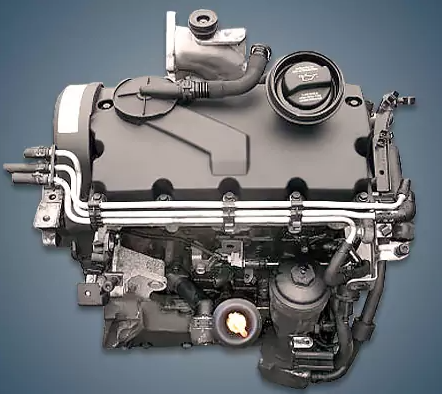
AJM, ASZ, AUY, AVB, AVF, AWX, AXB, AXC, BKC, BLS, and BXE are also included in the EA188-1.9 series.
Specifications
| Production years | 2005-2010 |
| Displacement, cc | 1896 |
| Fuel system | unit-injectors |
| Power output, hp | 105 |
| Torque output, Nm | 250 |
| Cylinder block | cast iron R4 |
| Block head | aluminum 8v |
| Cylinder bore, mm | 79.5 |
| Piston stroke, mm | 95.5 |
| Compression ratio | 19.0 |
| Features | SOHC |
| Hydraulic lifters | yes |
| Timing drive | belt |
| Phase regulator | no |
| Turbocharging | VGT |
| Recommended engine oil | 5W-40 |
| Engine oil capacity, liter | 3.8 |
| Fuel type | diesel |
| Euro standards | EURO 3/4 |
| Fuel consumption, L/100 km (for Volkswagen Passat 2005) — city — highway — combined |
7.4 4.3 5.7 |
| Engine lifespan, km | ~320 000 |
The engine was installed on:
- Audi A3 2 (8P) in 2004 – 2009;
- Seat Altea 1 (5P) in 2004 – 2010;
- Seat Leon 2 (1P) in 2005 – 2010;
- Seat Toledo 3 (5P) in 2004 – 2009;
- Skoda Octavia 2 (1Z) in 2004 – 2010;
- Volkswagen Golf 5 (1K) in 2004 – 2008;
- Volkswagen Jetta 5 (1K) in 2005 – 2007;
- Volkswagen Passat B6 (3C) in 2004 – 2008;
- Volkswagen Touran 1 (1T) in 2004 – 2010.
Disadvantages of the VW BKC engine
These engines break down at high mileage and have a wide margin of safety.
Leaks are frequently caused by unit injectors that are not securely fastened with a single bolt.
Stuck turbocharger geometry is a common cause of thrust dips.
The weak points of this diesel engine are also referred to by servicemen as a tandem pump.
Hydraulic lifters and camshaft cams deteriorate rapidly due to poor oil.