
Since 2012, the company has assembled and installed the 2.0-liter VW CRMB or Golf 7 2.0 TDI diesel engine on several of its mass-market vehicles, including the Volkswagen Golf, Skoda Octavia, and Seat Leon. Because of its installation in the third generation Octavia, this diesel is now widely used.
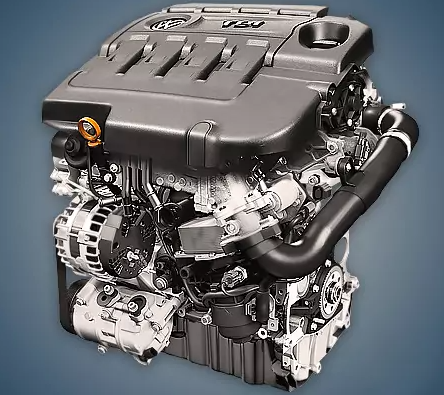
DCXA, CRLB, CRMB, DETA, DBGC, DFGA, DFBA, and DAUA are also part of the EA288 series.
Specifications
| Production years | since 2012 |
| Displacement, cc | 1968 |
| Fuel system | Common Rail |
| Power output, hp | 150 |
| Torque output, Nm | 320 |
| Cylinder block | cast iron R4 |
| Block head | aluminum 16v |
| Cylinder bore, mm | 81 |
| Piston stroke, mm | 95.5 |
| Compression ratio | 16.2 |
| Features | DOHC |
| Hydraulic lifters | yes |
| Timing drive | belt |
| Phase regulator | no |
| Turbocharging | Mahle BM70B |
| Recommended engine oil | 5W-30 |
| Engine oil capacity, liter | 4.6 |
| Fuel type | diesel |
| Euro standards | EURO 5/6 |
| Fuel consumption, L/100 km (for Volkswagen Golf 2017) — city — highway — combined |
5.3 3.9 4.4 |
| Engine lifespan, km | ~330 000 |
The engine was installed on:
- Seat Leon 3 (5F) in 2015 – 2020;
- Skoda Octavia 3 (5E) in 2012 – 2020;
- Volkswagen Golf 7 (5G) in 2014 – 2020.
Disadvantages of the VW CRMB engine
There are currently no significant flaws found in this diesel engine;
Bad fuel is not tolerated by modern fuel equipment, and repairs are costly;
Similar to many diesel engines, soot quickly clogs the EGR valve;
The timing belt serves 210 thousand kilometers in accordance with the regulations, but the pump may fail sooner;
Pouring oils with VW 507.00 approvals is advised; otherwise, the particulate filter won’t last very long.