
Only charged versions of the well-liked first-generation Q7 crossover were equipped with the 6.0-liter Audi CCGA or V12 TDi diesel engine between 2008 and 2012. The most potent diesel engine ever fitted to a civilian vehicle is this one.
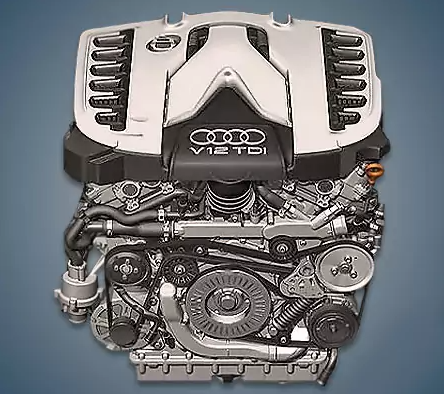
The EA898 series also includes: AKF, ASE, BTR, CKDA, CCGA, CZAC, DHVA.
A 5.5-liter V12 diesel engine made its debut on the Audi R10 race car in 2006. It was later modified to fit the Q7 crossover, where its volume was increased to 5.9 liters. This V-engine’sdesignincludes a cast-iron block with a 60° camber angle, aluminum DOHC cylinder heads with hydraulic lifters, a multi-chain timing drive, two Garrett GTB2260VK water-cooled turbochargers, two intercoolers, and a Bosch Common Rail fuel system with piezo injectors for 2000 bar. With 500 horsepower and 1000 Nm, the outcome is the most potent diesel engine for passenger cars.
Specifications
| Production years | 2008-2012 |
| Displacement, cc | 5934 |
| Fuel system | Common Rail |
| Power output, hp | 500 |
| Torque output, Nm | 1000 |
| Cylinder block | cast iron V12 |
| Block head | aluminum 48v |
| Cylinder bore, mm | 83 |
| Piston stroke, mm | 91.4 |
| Compression ratio | 16.0 |
| Hydraulic lifters | yes |
| Timing drive | chains |
| Turbocharging | two Garrett GTB2260VK |
| Recommended engine oil | 5W-30, 5W-40 |
| Engine oil capacity, liter | 13.0 |
| Fuel type | diesel |
| Euro standards | EURO 5 |
| Fuel consumption, L/100 km (for Audi Q7 2009) — city — highway — combined |
14.8 9.3 11.3 |
| Engine lifespan, km | ~500 000 |
| Weight, kg | 360 |
The engine was installed on:
- Audi Q7 1 (4L) in 2008 – 2012.
Disadvantages of the Audi CCGA engine
With this diesel, the Q7 has ten radiators that must be cleaned on a regular basis to prevent the engine from continuously overheating and oil leaking out of all of its seals.
The CR Bosch system is incredibly dependable, but the piezo injectors require high fuel quality; if you add anything to the tank, they might need to be replaced after 100,000 kilometers.
Both of these turbochargers are highly thermally loaded despite water cooling, and excessively active owners typically don’t travel more than 100–150 thousand kilometers.
The swirl flaps of the intake manifold are another weak point of the motor; either the hinges break or the electric motors of their drive frequently malfunction.
Additionally, the EGR system frequently clogs up due to control unit failures.