
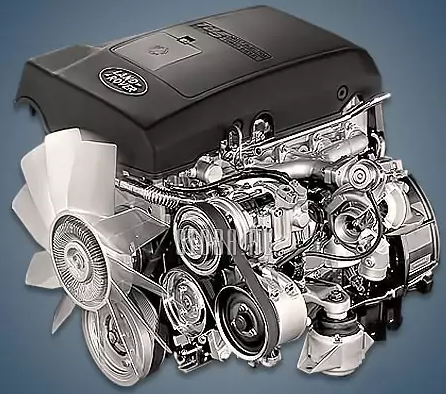
Between 1998 and 2002, the Defender SUV and Discovery II were equipped with the 2.5-liter Land Rover TD5 diesel engine, which had a 10P index and a 14P index, respectively. These units were given the designations 15P and 16P after being updated to meet Euro 3 environmental standards.
Specifications
| Production years | 1998-2002 |
| Displacement, cc | 2495 |
| Fuel system | pump-injectors |
| Power output, hp | 122 – 136 |
| Torque output, Nm | 300 – 315 |
| Cylinder block | cast iron R5 |
| Block head | aluminum 10v |
| Cylinder bore, mm | 84.45 |
| Piston stroke, mm | 88.95 |
| Compression ratio | 19.5 |
| Features | SOHC |
| Hydraulic lifters | no |
| Timing drive | double row chain |
| Phase regulator | no |
| Turbocharging | Garrett GT2052S |
| Recommended engine oil | 5W-30 |
| Engine oil capacity, liter | 7.3 |
| Fuel type | diesel |
| Euro standards | EURO 2 |
| Fuel consumption, L/100 km (for Land Rover Discovery TD5 2000) — city — highway — combined |
11.5 8.2 9.4 |
| Engine lifespan, km | ~350 000 |
The engine was installed on:
- Land Rover Defender 1 (L316) in 1998 – 2002;
- Land Rover Discovery 2 (L318) in 1998 – 2002.
Disadvantages of the Land Rover 10P TD5 engine
Breaks in the electrical wiring beneath the valve cover are the primary issue, followed by the pump-injector drive’s cams and rockers wearing down quickly.
Fuel and oil are combined as a result of the injectors’ sealing rings being destroyed;
In addition to cracking of the cylinder head and crankshaft damper pulley, the turbine’s axis frequently bypasses damper wedges and its control valve fails.