
In 1991, the Renault E7J 1.4-liter 8-valve engine made its debut. It is structurally similar to the well-known Cleon-Fonte engine, but it has an overhead camshaft in the cylinder head. installed on the Dacia Solenza, SupeRNova, Renault 19, Megane, Kangoo, and Clio. The E6J is the engine version with a carburetor power system.
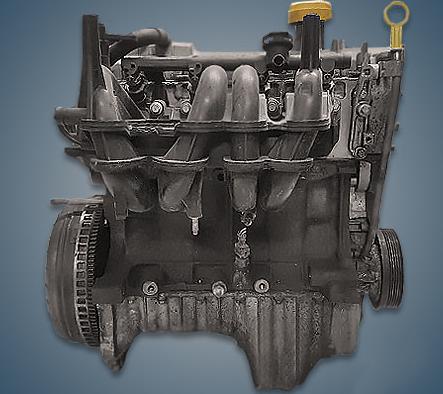
The E7F is another member of the E-series.
The engineers of the company eventually came to the conclusion that the OHV-type C-series engines could not produce any more at the end of the 1980s. It’s time to switch to the OHC scheme, which uses a toothed belt to transfer torque from the crankshaft and a camshaft in the cylinder head.
As a result, the E-series emerged, laying the groundwork for a vast family of low-volume power units with indices K and D that are currently being installed on several of the Franco-Japanese alliance’s budget models. Naturally, distributed injection has replaced mono-injection over time, but the design foundation hasn’t changed much in thirty years.
A new 1.4-liter K7J engine that eventually switched from wet liners to a cast block was introduced in 1997. Nevertheless, the outdated motor was installed on Romanian Dacia vehicles and kept in the conveyor for nearly ten more years.
The engine was mounted on:
- Dacia Solenza 1 (B41) in 2003 – 2005;
- Dacia SupeRNova 1 (B41) in 2000 – 2003;
- Renault 19 (X53) in 1993 – 1995;
- Renault Clio 1 (X57) in 1991 – 1998; Clio 2 (X65) in 1998 – 2001;
- Renault Express 1 (X40) in 1991 – 1998;
- Renault Kangoo 1 (KC) in 1997 – 2001;
- Renault Megane 1 (X64) in 1995 – 2000;
- Renault Scenic 1 (J64) in 1996 – 2003.
Specifications
| Production years | 1991-2005 |
| Displacement, cc | 1390 |
| Fuel system | mono-injection |
| Power output, hp | 70 – 80 |
| Torque output, Nm | 105 – 114 |
| Cylinder block | R4 |
| Block head | 8v |
| Cylinder bore, mm | 75.8 |
| Piston stroke, mm | 77 |
| Compression ratio | 9.2 – 9.5 |
| Timing drive | belt |
| Turbocharging | no |
| Fuel type | petrol |
| Euro standards | EURO 1 |
| Engine lifespan, km | ~200 000 |
| Weight, kg | 122 |
Disadvantages of the Renault E7J engine
Air leaks, a burned-out lambda probe, a malfunctioning fuel pump, or a single injection nozzle failure are typically the causes of the power unit’s unstable operation.
A cracked distributor cover is frequently the cause of motor problems. Checking the candles and high-voltage wires is also worthwhile.
The engine’s electrical component is extremely erratic, particularly during rainy conditions. While many sensors can malfunction, let’s focus on the two most unreliable ones: the coolant temperature and the incoming air temperature.