
From 1987 to 2002, a Japanese company produced the 1.6-liter Toyota 4A-FE engine, which was fitted on several of the company’s well-known models, including the Avensis, Corolla, Celica, and Carina E. This engine was modified as usual, but a particularly cost-effective version of Lean Burn was also created.
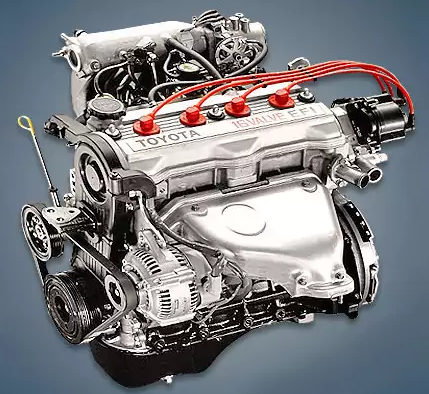
The engines 8A-FE, 5A-FE, 5A-FHE, 4A-FE, 4A-FHE, 4A-GE, 4A-GZE, and 7A-FE are also part of the A family.
This engine, a traditional injection 4-cylinder unit with a cast-iron block and a 16-valve aluminum head with two camshafts that are powered by a timing belt, debuted in 1987 alongside the updated E90 Corolla model. Because there are no hydraulic compensators, the valves must be changed every 100,000 kilometers.
This power unit comes in three generations total, each with an amazing array of variations:
- The large Toyota 16 VALVE EFI inscription on the valve cover makes it easy to identify the first generation, also known as 4A-FE Gen 1, which was manufactured between 1987 and 1996.
- The 4A-FE Gen 2, or second generation, was manufactured starting in 1992 and featured a gray valve cover. A more dependable ignition system, a MAP sensor, additional camshafts, a connecting rod piston group, and the relocation of the fuel injectors from the head to the intake manifold were the primary changes.
- From 1997 to 2002, only models intended for the Asian auto market were equipped with the third generation, which was characterized by a more advanced intake and exhaust system that boosted power by five horsepower.
The engine was installed on:
- Toyota Avensis 1 (T220) in 1997 – 2001;
- Toyota Carina 5 (T170) in 1987 – 1992; Carina 6 (T190) in 1992 – 1998;
- Toyota Celica 5 (T180) in 1989 – 1993;
- Toyota Corolla 6 (E90) in 1987 – 1992; Corolla 7 (E100) in 1991 – 1998; Corolla 8 (E110) in 1995 – 2002;
- Toyota Corolla Spacio 1 (E110) in 1997 – 2001;
- Toyota Corona 9 (T170) in 1988 – 1992; Corona 10 (T190) in 1992 – 1996; Corona 11 (T210) in 1996 – 2001;
- Toyota Sprinter 6 (E90) in 1988 – 1991; Sprinter 7 (E100) in 1992 – 1998; Sprinter E110 in 1995 – 2001.
Specifications
| Production years | 1987-2002 |
| Displacement, cc | 1587 |
| Fuel system | injector |
| Power output, hp | 100 – 115 |
| Torque output, Nm | 135 – 150 |
| Cylinder block | cast iron R4 |
| Block head | aluminum 16v |
| Cylinder bore, mm | 81 |
| Piston stroke, mm | 77 |
| Compression ratio | 9.5 |
| Hydraulic lifters | no |
| Timing drive | belt |
| Turbocharging | no |
| Recommended engine oil | 5W-30, 5W-40 |
| Engine oil capacity, liter | 3.2 |
| Fuel type | petrol |
| Euro standards | EURO 2 |
| Fuel consumption, L/100 km (for Toyota Carina E 1997) — city — highway — combined |
9.5 5.6 7.1 |
| Engine lifespan, km | ~300 000 |
| Weight, kg | 128 |
Disadvantages of the 4A-FE engine
In addition to using costly platinum candles and having abrupt traction dips that are nearly impossible to avoid, economical lean burn engines have very strict fuel quality requirements.
There are no obvious flaws in Series A motors, and all of their issues stem from aging. Piston pin knocks at high mileage are still a branded sore, though. Naturally, check the valves’ thermal clearances first because they frequently knock.
A burned-out lambda probe is frequently the cause of a sudden increase in fuel consumption, and a temperature sensor failure results in the engine not starting at all. Both the throttle position sensor and the absolute pressure sensor frequently malfunction.
Lubricant consumption frequently reaches 1 liter per 1000 kilometers of run after 200,000 kilometers. Piston rings and valve stem seal wear could be the cause.
This engine frequently has issues with trifles: nozzles and a throttle valve become dirty rather quickly, which causes the speed to float, the unit to triple or vibrate, ignition system malfunctions are common, the crankshaft oil seal occasionally flows, etc.