
From 1990 until 2003, the company produced the 1.5-liter 16-valve Toyota 5E-FE engine, which was fitted on numerous well-known models, including the Tercel, Cynos, Corolla, and Caldina. The ACIS system and evil camshafts on the sports version of the engine gave it a different index, 5E-FHE.
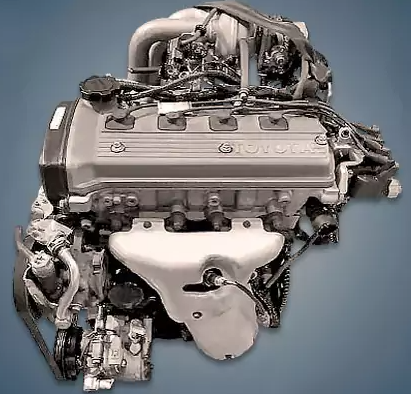
When this motor was first released in 1990, many small cars started to use it right away. The design, which featured a 16-valve aluminum cylinder head without hydraulic lifters and a 4-cylinder in-line cast-iron block with belt-driven timing, was iconic for its day. Depending on the particular Toyota model, the engine produced between 90 and 105 horsepower.
This unit underwent a significant update in 1995: the OBD-type diagnostic system was replaced with the more recent OBD-2, new pistons and connecting rods were installed, and a contemporary DIS-2 ignition system was added. The compression ratio rose from 9.4 to 9.8 as a result of using a 0.5 mm gasket rather than a 1.0 mm one.
The engines in the E 1.5 L family are the 3E, 3E-E, 3E-TE, 5E-FE, and 5E-FHE.
The engine was mounted on:
- Toyota Caldina 1 (T190) in 1992 – 1997;
- Toyota Corolla 7 (E100) in 1991 – 1998;
- Toyota Cynos L40 in 1991 – 1995; Cynos L50 in 1995 – 1999;
- Toyota Raum 1 (XZ10) in 1997 – 2003;
- Toyota Sera 1 (XY10) in 1990 – 1995;
- Toyota Tercel 4 (L40) in 1990 – 1994; Tercel 5 (L50) in 1994 – 1999.
Specifications
| Production years | 1990-2003 |
| Displacement, cc | 1497 |
| Fuel system | injector |
| Power output, hp | 90 – 105 |
| Torque output, Nm | 125 – 135 |
| Cylinder block | cast iron R4 |
| Block head | aluminum 16v |
| Cylinder bore, mm | 74 |
| Piston stroke, mm | 87 |
| Compression ratio | 9.4 – 9.8 |
| Hydraulic lifters | no |
| Timing drive | belt |
| Phase regulator | no |
| Turbocharging | no |
| Recommended engine oil | 5W-30, 5W-40 |
| Engine oil capacity, liter | 3.2 |
| Fuel type | petrol |
| Euro standards | EURO 2 |
| Fuel consumption, L/100 km (for Toyota Caldina 1995) — city — highway — combined |
9.7 6.0 7.5 |
| Engine lifespan, km | ~300 000 |
| Weight, kg | 115 |
Disadvantages of the Toyota 5E-FE engine
Overheating-related cylinder head gasket failure is the most frequent engine failure. Keep an eye on the cooling system because oil seals tan and flow for the same reason.
The oil burner, which begins after 150,000 kilometers, comes in second. The wear of the valve stem seals and piston rings is typically the cause of this.
Low-quality gasoline quickly clogs the fuel injectors, covers the throttle with soot, clogs the idle speed controller channel, and causes the engine to operate erratically.
Regulations state that the timing belt serves 100,000 kilometers, but it frequently extends much earlier. It’s advantageous that the motor’s valves hardly ever bend when it breaks and jumps.
Oil leaks, malfunctioning ignition system components, underutilized sensors, and, most importantly, the lambda probe are examples of minor but common malfunctions. Additionally, there are no hydraulic lifters, so valve clearances must be changed on a regular basis.